


How Much House Can I Afford in Kentucky? 2026 DTI Limits by Loan Program
Short answer: Kentucky lenders decide how much you qualify for using your debt-to-income ratio (DTI). Your new house payment usually needs to stay near 29–31% of your gross monthly income, and your house payment plus all other debts can reach 41–50% depending on the loan program. A household earning $75,000 with $450 a month in debts typically qualifies for about $219,000 (USDA) to $303,000 (conventional) at today's rates.
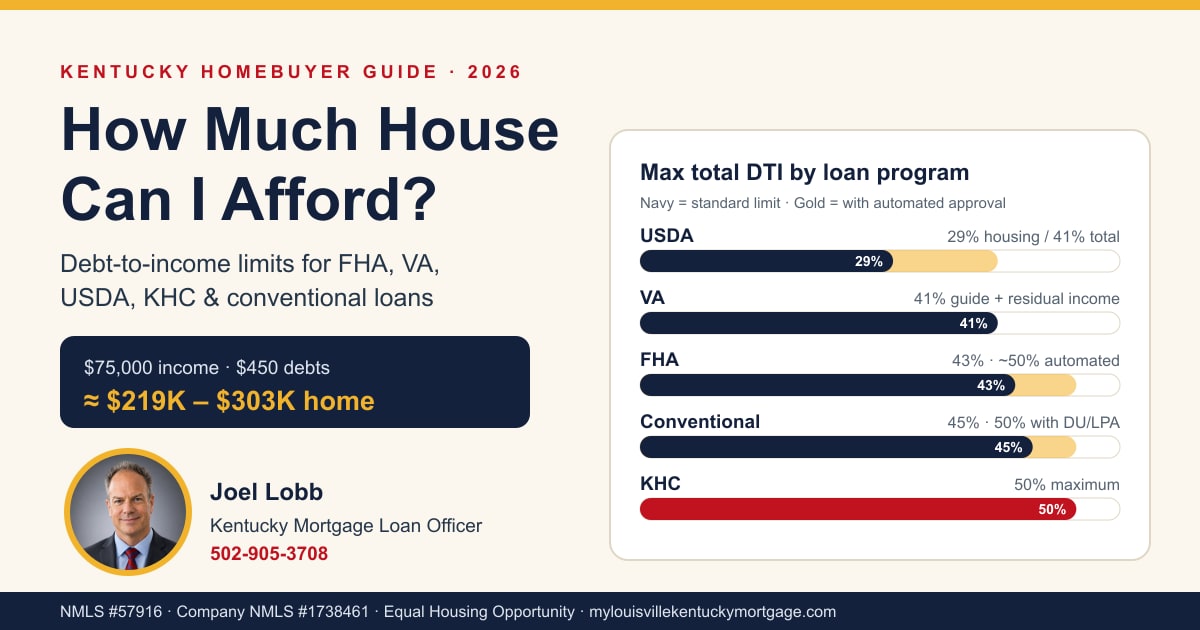
"How much house can I afford?" is the first question almost every Kentucky homebuyer asks me, and online calculators rarely agree. That is because each loan program (FHA, VA, USDA, KHC, and conventional) uses different debt ratio limits, mortgage insurance, and down payments. This guide shows you exactly how lenders run the numbers, gives you a calculator built on Kentucky assumptions, and walks through a real example across every program.
How much house can I afford in Kentucky on my salary?
Here is a starting point for a Kentucky buyer with $400 a month in other debts. FHA uses a 43% total DTI with 3.5% down. USDA uses its 29% housing ratio with zero down. Both assume a 6.75% rate, 0.9% property tax, and $150 a month for homeowners insurance.
| Gross annual income | Max house payment (FHA 43%) | FHA home price | USDA home price |
|---|---|---|---|
| $40,000 | $1,033/mo | ≈ $117,000 | ≈ $108,000 |
| $50,000 | $1,392/mo | ≈ $164,000 | ≈ $139,000 |
| $60,000 | $1,750/mo | ≈ $211,000 | ≈ $171,000 |
| $75,000 | $2,288/mo | ≈ $282,000 | ≈ $219,000 |
| $90,000 | $2,825/mo | ≈ $353,000 | ≈ $267,000 |
| $100,000 | $3,183/mo | ≈ $401,000 | ≈ $298,000 |
| $125,000 | $4,079/mo | ≈ $519,000 | Over the USDA income limit for 1–4 people |
Kentucky mortgage affordability calculator
Pick your loan program and the calculator loads that program's DTI limits, down payment, and mortgage insurance or funding fee. Change any number to match your situation.
How much house can I afford?
Call/Text 502-905-3708What is debt-to-income ratio, and how do Kentucky lenders calculate it?
Your debt-to-income ratio compares the monthly debts on your credit report, plus your new house payment, to your gross monthly income, which is your income before taxes and deductions. Lenders look at two versions of it:
- Front-end (housing) ratio: just the new house payment, which is principal, interest, property taxes, homeowners insurance, mortgage insurance, and any HOA dues. This is often called PITI.
- Back-end (total) ratio: the house payment plus every other monthly debt. This is the number most programs cap.
Counts in your DTI
- New mortgage payment (PITI + MI + HOA)
- Car loans and leases
- Student loans, including deferred ones (see below)
- Minimum credit card payments
- Personal loans, 401(k) loans for some programs
- Child support and alimony
- Co-signed debts, unless the other party has made 12 months of payments
Does not count
- Your current rent (it goes away)
- Utilities, phone, internet, streaming
- Car and health insurance
- Groceries, gas, childcare*
- Installment debts with 10 or fewer payments left (for most programs)
- Medical collections, in most cases
2026 Kentucky DTI limits by loan program
These are the ratios lenders use today. "Automated approval" means an approve or accept finding from FHA TOTAL Scorecard, Fannie Mae DU, Freddie Mac LPA, or USDA GUS. Strong credit, cash reserves, and a small payment increase over your current rent can push those systems past the standard limits.

| Program | Housing / total DTI | With automated approval | Down payment | Min. credit score |
|---|---|---|---|---|
| FHA | 31% / 43% | Often up to ~50%; strongest files higher | 3.5% | 580 (500 with 10% down) |
| VA | 41% total guideline | No hard cap. Residual income decides. | $0 | No VA minimum (lenders ~580–620) |
| USDA | 29% / 41% | GUS Accept can go higher | $0 | 640 for GUS |
| KHC (with FHA, VA, USDA, or conventional) | Follows the first mortgage | 50% maximum total DTI | DPA up to $12,500 | 620 |
| Conventional | 36% manual (to 45%) | Up to 50% with DU/LPA | 3–5% | 620 |
Kentucky FHA debt-to-income ratio
FHA's baseline is a 31% housing ratio and 43% total DTI. Most FHA loans are approved through the automated TOTAL Scorecard, which routinely accepts total ratios near 50% for borrowers with steady income and decent credit. When a file is manually underwritten, HUD's ratio table applies: 31/43 with no compensating factors, 37/47 with one, and 40/50 with two, such as three months of reserves, minimal payment shock, or significant additional income. There is also 40/40 when you have no discretionary debt. Borrowers under a 580 score are held to 31/43. See my Kentucky FHA loan guide for the full requirements.
Kentucky VA loan DTI and residual income
VA uses 41% total DTI as a guideline, not a ceiling. What really matters is residual income, the money left each month after your house payment, debts, taxes, and estimated maintenance. Kentucky is in VA's South region. For loans of $80,000 or more, the minimums are:
| Family size | 1 | 2 | 3 | 4 | 5 |
|---|---|---|---|---|---|
| Residual income | $441 | $738 | $889 | $1,003 | $1,039 |
Add $80 for each family member over five. If your DTI is above 41%, VA wants residual income at least 20% above the table. Full details are in the VA residual income chart and the Kentucky VA loan page.
Kentucky USDA loan DTI
USDA Rural Development sets ratios of 29% for housing and 41% total. That 29% housing cap is why USDA often approves a smaller price than FHA for the same household. A GUS Accept can exceed those ratios. On a manually underwritten file, a ratio waiver up to 32/44 is possible with a 680+ credit score and a documented compensating factor. USDA also caps household income. Most Kentucky counties allow $122,800 for 1–4 people and $162,100 for 5–8 people. Check eligibility on the Kentucky USDA loan page.
KHC down payment assistance DTI
Kentucky Housing Corporation loans sit on top of an FHA, VA, USDA, or conventional first mortgage. They follow that program's rules, with a hard 50% total DTI cap and a 620 minimum score. The down payment assistance of up to $12,500 is a repayable second loan, so its monthly payment is added to your debts. KHC also caps income and purchase price, at $566,354 for 2026. See KHC loan programs and DPA.
Conventional loan DTI in Kentucky
Fannie Mae and Freddie Mac allow up to 50% total DTI with an automated approval. Manually underwritten conventional loans start at 36%, with up to 45% allowed when credit score and reserve requirements are met. Private mortgage insurance is priced by credit score, so a 740 score costs far less per month than a 640, and that difference changes your price range.
Real example: same Kentucky buyer, five different answers
Take a household earning $75,000 a year ($6,250 a month) with $450 in monthly debts (a car payment and a credit card). Assume a 6.75% rate, 0.9% property tax, and $1,800 a year for insurance:
| Program | Ratio used | Max house payment | Est. home price | Down payment |
|---|---|---|---|---|
| USDA | 29% housing cap | $1,812 | ≈ $219,000 | $0 |
| FHA (manual) | 31% / 43% | $1,938 | ≈ $236,000 | ≈ $8,300 |
| VA | 41% total | $2,112 | ≈ $266,000 | $0 |
| FHA (automated) | 43% total | $2,237 | ≈ $276,000 | ≈ $9,700 |
| Conventional | 45% total | $2,362 | ≈ $303,000 | ≈ $15,200 |
| FHA or VA (strong automated approval) | 50% total | $2,675 | ≈ $334,000–$342,000 | FHA 3.5% / VA $0 |
Qualifying at 50% does not mean you should borrow at 50%. At that level about half of your pre-tax income goes to debt. I show every buyer both the maximum and a comfortable number, and you choose.
How your debts cut your buying power
For the $75,000 household above, FHA buying power is about $335,000 with no debts, $276,000 with $450 in debts, and only $216,000 with $900 in debts. Paying off a $400 car loan before you apply can add roughly $50,000 to your price range. Do not pay off debts in the middle of a loan without asking your loan officer first, because moving cash can create asset documentation issues.
How student loans are counted
| Program | Payment counted |
|---|---|
| FHA | The actual payment; if $0 or deferred, 0.5% of the balance |
| VA | 5% of the balance ÷ 12, unless deferred 12+ months past closing or a documented lower payment |
| USDA | The actual payment; if $0 or deferred, 0.5% of the balance |
| Conventional (Fannie Mae) | A documented income-driven payment, even $0; if deferred, 1% of the balance |
Video: How much house can you afford in Kentucky?
7 ways to qualify for a bigger Kentucky mortgage
- Pay down credit card balances. Lower balances lower your minimum payments and can raise your score, and a better score means a better rate.
- Pay off installment loans that are close to done. Loans with 10 or fewer payments left are often excluded.
- Count all eligible income. Overtime, bonus, and part-time income usually count with a two-year history. See what lenders look at.
- Add a co-borrower. FHA also allows a non-occupant co-borrower, such as a parent.
- Choose the right program. The same buyer can see a $50,000+ swing between USDA's 29% cap and FHA or conventional.
- Buy down the rate. Seller-paid closing costs can buy points, which lowers the payment you qualify with.
- Don't open new credit before closing. That includes a new car, furniture financing, or buy-now-pay-later plans.
Affordability calculator vs. pre-approval
A calculator uses the numbers you type. A pre-approval uses your verified income, your actual credit report, and a real automated underwriting finding. That is why a pre-approval can come in higher or lower than any calculator. It is also what Kentucky sellers and agents expect to see with an offer. Start with the free Kentucky pre-qualification form, check the credit score you need, or compare payments on the first-time homebuyer guide. For a deeper look at each program's ratio rules, read Kentucky DTI requirements by loan program.
Get your real number, not an estimate
I'll run your income, debts, and credit through FHA, VA, USDA, KHC, and conventional guidelines and show you the maximum and a comfortable price for each. Usually the same day.
Call or text 502-905-3708 Start my free pre-approvalFrequently asked questions
How much mortgage can I qualify for with a $75,000 salary in Kentucky?
With $450 in monthly debts and a 6.75% rate, about $219,000 with USDA, $266,000 with VA, $276,000 with FHA, and $303,000 with conventional (5% down). Fewer debts or a strong automated approval can push that higher.
What is the maximum debt-to-income ratio for a Kentucky mortgage?
It depends on the program. FHA is 43% as a baseline and often about 50% with an automated approval. VA uses 41% as a guideline plus residual income. USDA is 29%/41%, KHC caps total DTI at 50%, and conventional loans allow up to 50% with DU or LPA approval.
Does rent count in my debt-to-income ratio?
No. Your current rent is replaced by the new house payment, so it is not counted. Utilities, phone bills, and car insurance also are not counted.
Why does USDA approve me for less than FHA?
USDA limits the house payment to 29% of gross income, while FHA's automated approvals focus mainly on the total ratio. USDA also includes a 0.35% annual fee and has household income limits.
Does KHC down payment assistance affect how much I qualify for?
Yes. KHC's DPA is a repayable second loan, so its monthly payment is added to your debts. KHC also caps total DTI at 50% and purchase price at $566,354 in 2026.
Should I buy at the maximum amount I'm approved for?
Not necessarily. Approval limits are ceilings, not budgets. Leave room for savings, repairs, and childcare. I show every client a maximum and a comfortable payment before they shop.

