Showing posts with label Kentucky USDA Loans. Show all posts

How to Get Approved for a USDA Mortgage Loan in Kentucky

How to Get Approved for a USDA Mortgage Loan in Kentucky

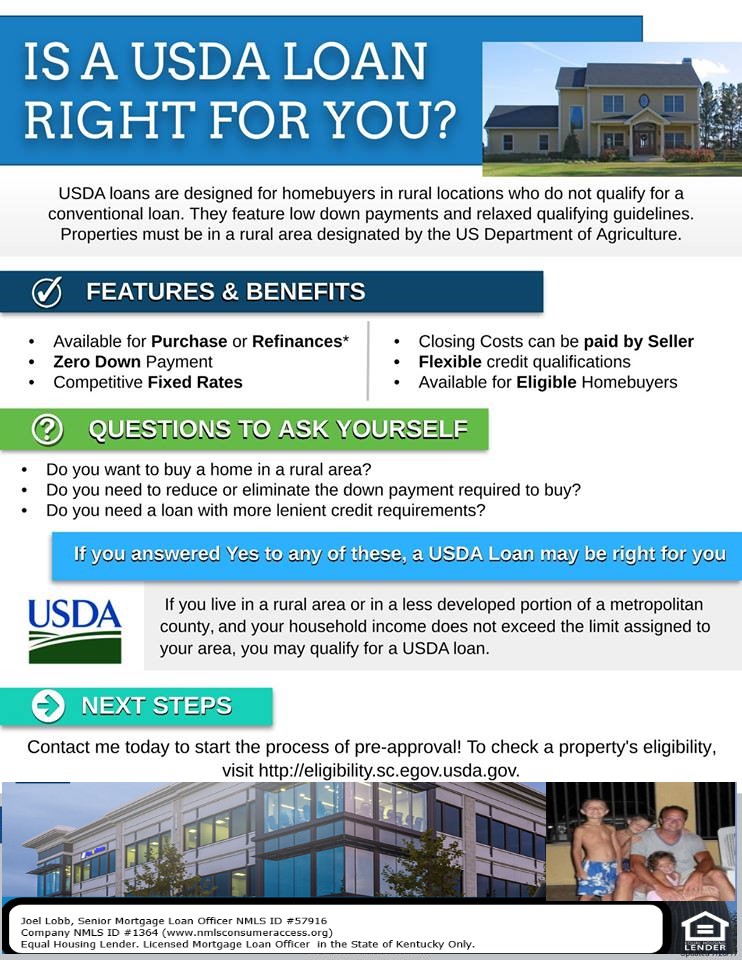
If you are planning to buy a home in Kentucky and want a zero-down mortgage option, a USDA Rural Housing loan may be a strong fit. USDA loans are backed by the U.S. Department of Agriculture and are designed to help low-to-moderate income households purchase a primary residence in eligible rural areas of Kentucky.

Below is a practical breakdown of how USDA loan approval works in Kentucky, including credit score expectations, income limits, employment history, debt-to-income ratios, and bankruptcy or foreclosure guidelines.

  1. Credit score requirements for Kentucky USDA loans
    • USDA does not publish a hard minimum credit score, but in real-world lending a 640 or higher middle score is typically required for automated GUS approval.
    • Scores below 640 may still be eligible through manual underwriting with strong compensating factors such as stable income, reserves, or positive rental history.
    • While USDA technically allows scores down to 580, very few lenders will approve these files without strict underwriting review and higher risk pricing.
  2. USDA income eligibility in Kentucky
    • USDA counts total household income, not just the income of borrowers on the loan.
    • Household income must fall within USDA limits for the specific Kentucky county and household size.
    • Income limits change annually and must be verified using current USDA data.
  3. Employment and work history
    • Most borrowers need a two-year employment history in the same line of work.
    • Gaps may be acceptable if they are explainable and the borrower is currently employed in a stable position.
  4. Property location requirements
    • The home must be located in a USDA-eligible rural area of Kentucky.
    • Many properties outside Louisville, Lexington, and Northern Kentucky qualify, but eligibility must be verified by address.
    • USDA loans are available in most of Kentucky’s 120 counties, subject to map eligibility.
  5. Debt-to-income ratio guidelines
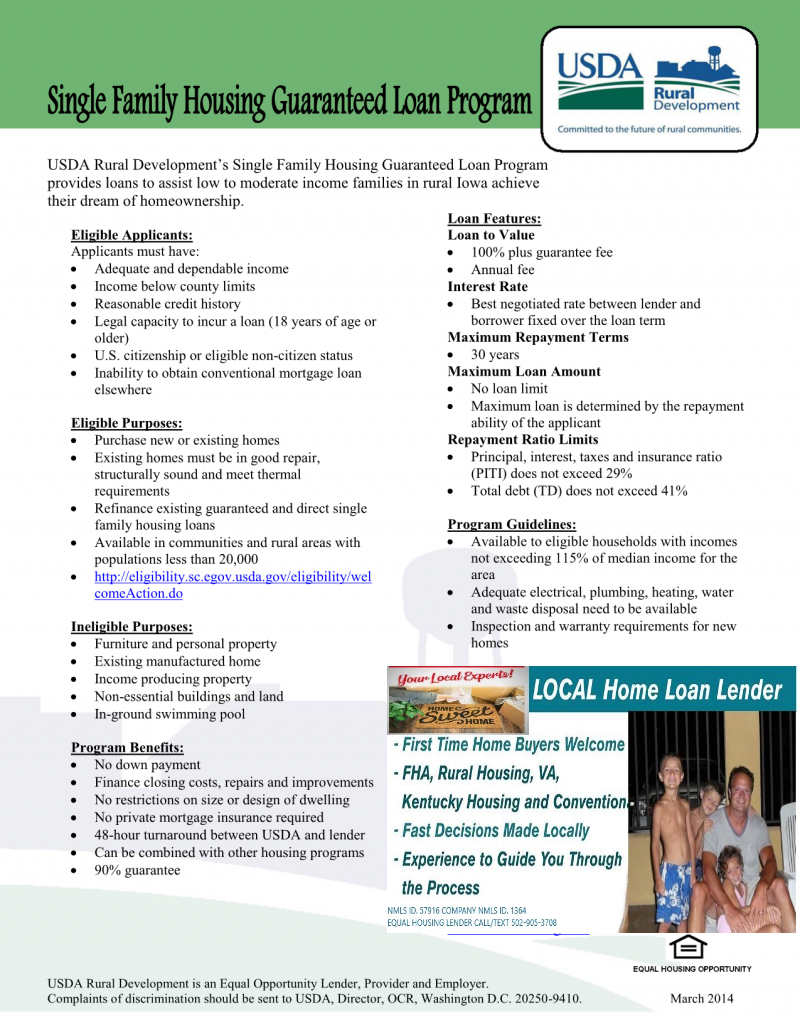
    • Standard USDA ratios are 29% for housing and 41% for total debt.
    • Higher ratios may be approved with an automated GUS approval or strong compensating factors.
  6. USDA income limits
    • Income limits vary by county and household size.
    • In many Kentucky rural counties, limits typically range from approximately $112,450 to $148,450 depending on family size.
    • These limits update yearly and must be verified at time of application.
  7. Eligible property types
    • USDA loans are for owner-occupied primary residences only.
    • Eligible properties include single-family homes, townhomes, and approved condominiums.
    • Investment properties and vacation homes are not allowed.
  8. Bankruptcy and foreclosure waiting periods
    • Chapter 7 bankruptcy: generally 3 years from discharge.
    • Chapter 13 bankruptcy: may be eligible after 12 months of on-time payments with court approval.
    • Foreclosure: generally 3 years from completion date.
  9. Closing timeline
    • Most Kentucky USDA loans close in approximately 30–45 days.
    • USDA loans require an additional USDA review step, which can add time if the file is not complete.
  10. Appraisal and inspections
    • A USDA appraisal is required to confirm value and property condition.
    • Termite inspections may be required depending on property type and location.
  11. GUS and manual underwriting
    • USDA uses the Guaranteed Underwriting System (GUS) to evaluate risk.
    • Files that do not receive an automated approval may still qualify through manual underwriting.

Steps to get a Kentucky USDA loan

  1. Confirm property eligibility using the USDA eligibility map.
  2. Verify household income limits for the county.
  3. Apply for pre-approval with a USDA-experienced lender.
  4. Shop for an eligible home and sign a purchase contract.
  5. Complete appraisal, underwriting, USDA approval, and closing.

USDA Guaranteed loans require a 1% upfront guarantee fee and a 0.35% annual fee, which is paid monthly. These fees are typically lower than FHA mortgage insurance and can be financed into the loan.

USDA loans offer 100% financing, a fixed 30-year rate, and competitive pricing for qualified Kentucky buyers who meet location and income requirements.

Posted by Joel Lobb, Mortgage Broker FHA, VA, KHC, USDA
Text or call: 502-905-3708
Email: kentuckyloan@gmail.com

Equal Opportunity Lender. NMLS #57916. Loan approval subject to underwriting guidelines and program requirements.

Do I Qualify for a Kentucky USDA Loan?

Before you start home shopping, confirm these four items: the home’s location, your household income, your credit profile, and your debt-to-income ratio. If those line up, USDA can be one of the strongest zero-down loan options in Kentucky.

Check My USDA Eligibility

Comparing loan options? You may also want to review:

Kentucky USDA Property Eligibility Map

USDA loans are only available for homes located in eligible rural areas. Use the official USDA address lookup tool below to confirm whether a specific Kentucky property qualifies.

If the map does not load inside the page, click here to open it in a new tab .

Kentucky USDA Loan FAQs

Do USDA loans require a down payment?

No. USDA Guaranteed loans allow 100% financing for eligible buyers purchasing a primary residence in an approved rural area.

What credit score is needed for a USDA loan in Kentucky?

Most lenders prefer a 640 or higher credit score for automated approval. Scores below that may still qualify through manual underwriting with compensating factors.

Are USDA loans only for first-time buyers?

No. USDA loans are available to both first-time and repeat homebuyers, as long as all eligibility requirements are met.

How long does it take to close a USDA loan?

Most Kentucky USDA loans close in approximately 30–45 days. Timing can vary due to the required USDA final approval step.

Types of Kentucky Mortgages for Homebuyers in Kentucky


Here is a quick summary of the 3 loans for Kentucky Homebuyers , but we will go into each of them in depth further down.

Types of Kentucky mortgages

  1. Conventional loan – Best for borrowers with a good credit score

  2. Jumbo loan – Best for borrowers with excellent credit looking to buy an expensive home

  3. Government-insured loan – Best for borrowers who have lower credit scores and not much cash for a down payment

  4. Fixed-rate mortgage – Best for borrowers who want the predictability of the same payments throughout the entire loan

  5. Adjustable-rate mortgage – Best for borrowers who do not plan to stay in the home for a long time, and are comfortable with the risk of larger payments down the road

1. Kentucky Conventional Loan

Conventional loans are not backed by the federal government, and they come in two packages: conforming and non-conforming.

  • Conforming loans – As the name implies, a conforming loan “conforms” to a set of standards put in place by the Federal Housing Finance Agency (FHFA). The standards include a range of factors about your credit and debt, but one of the main pieces is the size of the loan.

  • Non-conforming loans – These loans do not meet FHFA standards. They might be for larger homes, or they might be offered to borrowers with subpar credit. Some non-conforming loans are designed for those who have gone through major financial catastrophes such as a bankruptcy.

Pros of conventional loans

  • Can be used for a primary home, second home or investment property

  • Overall borrowing costs tend to be lower than other types of mortgages, even if interest rates are slightly higher

  • Can ask your lender to cancel private mortgage insurance (PMI) once you’ve reached 20 percent equity, or refinance to remove it

  • Can pay as little as 3 percent down on loans backed by Fannie Mae or Freddie Mac

  • Sellers can contribute to closing costs

Cons of conventional loans

  • Minimum FICO score of 620 or higher often required (the same applies for refinancing)

  • Higher down payment than some government loans

  • Must have a debt-to-income (DTI) ratio of no more than 43 percent (50 percent in some instances)

  • Likely need to pay PMI if your down payment is less than 20 percent of the sales price

  • Significant documentation required to verify income, assets, down payment and employment

Who should get a conventional loan

If you have a strong credit score and can afford to make a sizable down payment, a conventional mortgage is probably your best pick.

The 30-year, fixed-rate conventional mortgage is the most popular choice for homebuyers.

2. Jumbo Loans

Jumbo mortgages are appropriately named: These are loans that fall outside FHFA limits.

Jumbo loans are more common in higher-cost areas such as Los Angeles, San Francisco, New York City and the state of Hawaii.

More money means more risk for the lender, so these generally require more in-depth documentation to qualify.

Pros of jumbo loans

  • Can borrow more money to buy a more expensive home

  • Interest rates tend to be competitive with other conventional loans

Cons of jumbo loans

  • Down payment of at least 10 percent to 20 percent needed

  • A FICO score of 700 or higher typically required

  • Cannot have a DTI ratio above 45 percent

  • Must show you have significant assets in cash or savings accounts

Who should get a jumbo loan?

If you’re looking to finance a sum of money larger than the latest conforming loan limits, a jumbo loan is likely your best route.

3. Kentucky Government-Insured Loan

The U.S. government isn’t a mortgage lender, but it does play a role in helping more Americans become homeowners.

Three government agencies back mortgages: the Federal Housing Administration (FHA loans), the U.S. Department of Agriculture (USDA loans) and the U.S. Department of Veterans Affairs (VA loans).

  • Kentucky FHA loans – Backed by the FHA, these types of home loans help make homeownership possible for borrowers who don’t have a large down payment saved up or don’t have pristine credit. FHA loans require two mortgage insurance premiums: one is paid upfront, and the other is paid annually for the life of the loan if you put less than 10 percent down, which can increase the overall cost of your mortgage. Lastly, with an FHA loan, the home seller is allowed to contribute to closing costs.

  • Kentucky USDA loans – USDA loans help moderate- to low-income borrowers buy homes in rural areas. You must purchase a home in a USDA-eligible area and meet certain income limits to qualify. Some USDA loans do not require a down payment for eligible borrowers with low incomes. There are extra fees, though, including an upfront fee of 1 percent of the loan amount (which can typically be financed with the loan) and an annual fee.

  • Kentucky VA loans – VA loans provide flexible, low-interest mortgages for members of the U.S. military (active duty and veterans) and their families. VA loans do not require a down payment or mortgage insurance, and closing costs are generally capped and may be paid by the seller. A funding fee is charged on VA loans as a percentage of the loan amount to help offset the program’s cost to taxpayers. This fee, as well as other closing costs, can be rolled into most VA loans or paid upfront at closing. Many lenders offer the lowest rates possible on VA loans, and some are willing to accept lower credit scores.

Pros of government-insured loans

  • Help you finance a home when you don’t qualify for a conventional loan

  • Credit requirements more relaxed

  • Don’t need a large down payment

  • Available to repeat and first-time buyers

  • No mortgage insurance and no down payment required for VA loans

Cons of government-insured loans

  • Mandatory mortgage insurance premiums on FHA loans that cannot be canceled unless refinancing into a conventional mortgage

  • Loan limits on FHA loans are lower than conventional mortgages in most areas, limiting potential inventory to choose from

  • Borrower must live in the property (although you may be able to finance a multi-unit building and rent out other units)

  • Could have higher overall borrowing costs

  • Expect to provide more documentation, depending on the loan type, to prove eligibility

Who should get a government-insured loan?

If you cannot qualify for a conventional loan due to a lower credit score or limited savings for a down payment, Kentucky FHA-backed and USDA-backed loans are a great option.

For military service members, veterans and eligible spouses, VA-backed loans can be a good option — often better than a conventional loan.


Other types of Kentucky home loans
In addition to these common kinds of Kentucky mortgages, there are other types you may find when shopping around for a loan:

  • Construction loans – If you want to build a home, a construction loan can be a good choice. You can decide whether to get a separate construction loan for the project and then a separate mortgage to pay it off, or wrap the two together (known as a construction-to-permanent loan). You typically need a higher down payment for a construction loan and proof that you can afford it.

  • Interest-only mortgages – With an interest-only mortgage, the borrower pays only the interest on the loan for a set period of time. After that time is over, usually between five and seven years, your monthly payment increases as you begin paying your principal. With this type of loan, you won’t build equity as quickly, since you’re initially only paying interest. These loans are best for those who know they can sell or refinance, or for those who can reasonably expect to afford the higher monthly payment later.

  • Piggyback loans – A piggyback loan, also referred to as an 80/10/10 loan, actually involves two loans: one for 80 percent of the home price and another for 10 percent. Then, you make a down payment of 10 percent. These are designed to help the borrower avoid paying for mortgage insurance. While eliminating those PMI payments might sound appealing, keep in mind that piggyback loans require two sets of closing costs and two loans accruing interest. You’ll need to crunch the numbers to find out if you’re really saving enough money to justify this unconventional arrangement.

  • Balloon mortgages – Another type of home loan you might come across is a balloon mortgage, which requires a large payment at the end of the loan term. Generally, you’ll make payments based on a 30-year term, but only for a short time, such as seven years. At the end of that time, you’ll make a large payment on the outstanding balance, which can be unmanageable if you’re not prepared.


Hope your day is full of sunshine😊

Joel Lobb  Mortgage Loan Officer

American Mortgage Solutions, Inc.
10602 Timberwood Circle
Louisville, KY 40223
Company NMLS ID #1364

Text/call: 502-905-3708
fax: 502-327-9119
email:
 kentuckyloan@gmail.com

http://www.mylouisvillekentuckymortgage.com/


NMLS 57916  | Company NMLS #1364/MB73346135166/MBR1574


The view and opinions stated on this website belong solely to the authors, and are intended for informational purposes only. The posted information does not guarantee approval
nor does it comprise full underwriting guidelines. This does not represent being part of a government agency. The views expressed on this post are mine and do not necessarily reflect the view of my employer. Not all products or services mentioned on this site may fit all people.
NMLS ID# 57916, (www.nmlsconsumeraccess.org).

Manufactured Home Requirements for Kentucky FHA, VA, USDA and Conventional Mortgage Loans


KENTUCKY MORTGAGE OPTIONS FOR MANUFACTURED HOMES


 Kentucky Mobile home Manufactured Homes including: Kentucky Conventional, Kentucky FHA, Kentucky VA and Kentucky USDA home loan programs.  


Kentucky Conventional Loans

  • Up to 95 LTV on purchases
  • 97 LTV Rate and Term REFI options for with an existing Fannie Mae loan through MH Advantage (see product snapshot for more info)
  • Purchase and rate and term options available for single wide, double wide and larger
  • Cash-out options available for double-wide and larger
  • Second home options available for double-wide and larger
  • Down to 580 FICO

Kentucky FHA Loans

  • Up to 96.5 LTV on purchases and 97.75 LTV on Rate and Term REFIs
  • Cash-out REFI options up to 80 LTV
  • Purchase, cash-out and Rate and Term REFI options available for single wide, double wide and larger
  • Down to 550 FICO
  • Manual underwrite options available
  • Manufactured homes are now available on FHA 203(k) products!

Kentucky VA Loans

  • Up to 100 LTV on purchases and Rate and Term REFIs
  • Up to 105 LTV for streamlined IRRRLs
  • Cash-out REFI options up to 90 LTV
  • Cash-out REFI options up to 80 LTV
  • Down to 550 FICO
  • Manual underwrite options available

Kentucky USDA Loans

  • Up to 100 LTV on purchases and Rate and Term REFIs
  • Purchase and Rate and Term REFI options available for single wide, double wide and larger
  • Down to 580 FICO
  • Manual underwrite options available


Joel Lobb
Mortgage Loan Officer

Individual NMLS ID #57916


American Mortgage Solutions, Inc.
10602 Timberwood Circle
Louisville, KY 40223
Company NMLS ID #1364


Text/call: 502-905-3708
fax: 502-327-9119
email:
 kentuckyloan@gmail.com

http://www.mylouisvillekentuckymortgage.com/

The view and opinions stated on this website belong solely to the authors, and are intended for informational purposes only. The posted information does not guarantee approvalnor does it comprise full underwriting guidelines. This does not represent being part of a government agency. The views expressed on this post are mine and do not necessarily reflect the view of my employer. Not all products or services mentioned on this site may fit all people.
NMLS ID# 57916, (www.nmlsconsumeraccess.org).

Kentucky Rural Housing USDA Guideline Updates for 2023

As a reminder, annual income differs from repayment income. Annual income for the household will be used to calculate the adjusted annual household income to determine eligibility for a USDA-guaranteed loan. The main purpose of the following revisions in paragraph 9.3 is to ensure that lenders are aware that they are to calculate and properly document all adult household members’ income for annual income eligibility purposes…not just parties to the loan note.

It’s important to be aware of income sources that are counted and NOT counted as well as how to properly determine both “annual” and “repayment” income. I recommend that you thoroughly read Chapter 9 and refer to Attachment 9-A and Attachment 9-D in HB-1-3555 to review income and asset types, guidance for annual and repayment purposes, and documentation options acceptable to verify the income or asset source.

Paragraph 9.3 is being revised as follows:

  • To clarify that lenders must verify the income of each adult household member for the previous 2 years.
  • To clarify, under “full income documentation”, the lender must obtain W-2s or IRS Wage and Income transcripts in addition to paystubs.
  • To change the term “streamlined documentation” to “alternative income documentation” to remove confusion with the streamlined refinance product.
  • To clarify under “self-employed income documentation,” if ownership interest is less than 25%, neither the “Business Owner” nor “Self-Employed” options should be selected in GUS (Guaranteed Underwriting System).
  • To clarify the Verbal Verification of Employment must be obtained within 10 business days of loan closing, and confirmation a self-employment business remains operational must be obtained within 30 days of loan closing.
  • Restructured guidance on tax transcripts to emphasize a failure to timely file tax returns is not an eligible explanation to forgo obtaining tax transcripts.

Paragraph 9.8: STABLE AND DEPENDABLE INCOME

Gaps In Employment: The Agency clarifies that it is the lender’s responsibility to analyze any gaps in employment to make a final determination of stable and dependable income. The Agency does not impose specific criteria regarding when a gap in employment is acceptable. It is the approved lender’s responsibility to analyze the complete employment history to determine stable and dependable income.

Business loss from a closed business:

The Agency clarifies that any loss incurred by a self-employed business (full-time or part-time) that is closed may be removed from consideration when the applicant provides a letter of explanation and documentation to the lender which details:

  • When the business was closed;
  • Why the business was closed;
  • How the business was closed; and
  • Evidence satisfactory to the lender to support the closure of the business.

Attachment 9-A: INCOME AND DOCUMENTATION MATRIX

Considerations for Income Calculations: The Agency added additional considerations to the “Considerations for All Income Calculations” section of the matrix to provide important reminders to lenders regarding reviewing and calculating income. The full text of the revision is as follows:

  • Annual and adjusted annual income calculations must include all eligible income sources from all adult household members, not just parties to the loan note.
  • Annual income is calculated for the ensuing 12 months based on income verifications, documentation, and household composition.
  • Include only the first $480 of earned income from adult full-time students who are not the applicant, co-applicant, or spouse of an applicant in annual and adjusted annual income.
  • Income from assets that meet the criteria of Section 9.4 must be included in annual and adjusted annual income.
  • Repayment income calculations include the income sources of the applicants who will be parties to the note that meet the minimum required history identified in this matrix and have been determined to be stable and dependable income by the approved lender.
  • Income used in repayment income calculations must be confirmed to continue a minimum of three years into the mortgage. If the income is tax-exempt, it may be grossed up to 25 percent for repayment income. “Documentation Source Options” lists eligible documentation. Every item listed is not required unless otherwise stated. Lenders must obtain and maintain documentation in the loan file supporting the lender’s income calculations.

Automobile Allowance: Revised “Automobile Allowance” guidance to allow the full allowance to be included as repayment income and the full expense (debt) counted in DTI, as well as updating the required history to two years. 

Comment: Previously, a 1-year history was required. The wording in this section is much better in that it clarifies the intent of the agency to allow for the automobile allowance to be counted as income and the debt associated with that income, if any (such as a car payment), counted in the DTI.  

Boarder Income: The Agency clarified that “Boarder Income” refers to rental income received from an individual renting space inside the dwelling, making the property income-producing and, therefore, ineligible.

Comment: This revision to attachment 9-A, “Boarder Income,” makes it clear that boarder income will render the property ineligible for a guaranteed loan. The previous guidance made it somewhat appear as if boarder income was acceptable. It’s not.

Bonus Income: Revised “Bonus” income to clarify the one-year history must be in the same or similar line of work.

Comment: This is a significant revision in that previously, the guidance made it appear the income had to be on the same job…not the same or similar line of work. This gives the lender greater flexibility in counting this type of income.

Child Support: Revised the “Child Support” guidelines to simplify the guidance and remove inconsistencies. The Agency stated that child support that meets the minimum history but the payment amounts are not consistent must use an average consistent with the payor’s current ability/willingness to pay.

Comment: While perhaps not readily apparent, the wording in this revised guidance is significant in that it gives lenders greater latitude in using “Child Support” income. 

Employee Fringe Benefits: The Agency clarified that employer-provided fringe benefits that are reported as taxable income may be included in repayment income. The actual guidance states the following: Employer-provided fringe benefit packages documented on earning statements as taxable income may be included.

Expense AllowanceRevised “Expense Allowance” guidance to allow the full allowance to be included as repayment income and the full expense (debt) counted in DTI, as well as updating the required history to two years.

Comment: Previously, a 1-year history was required. The wording in this section is much better in that it clarifies the intent of the agency to allow for the expense to be counted as income and the debt associated with that income, if any, counted in the DTI.  

Guardianship/Conservatorship Income: The Agency added a category providing guidance on “Guardianship/Conservatorship Income.” This guidance does not apply to income earned from foster care. Include amounts that will be received in the ensuing 12 months. Exclusions may apply under 7 CFR 3555.152(b)(5).

Required History: None; the income must be received at the time of submission to the Agency. Lenders must document:

  • The applicant is currently receiving the income; and
  • The amount of income received each month.

Continuance: Benefits that do not include expiration dates on the documentation will be presumed to continue.

Documentation Source Options:

  • Documentation to support payment amounts and duration, such as a court order, legal documents, or other supplemental information
  • Online payment schedule from the Agency, bank statements, etc.
  • Federal income tax returns or IRS tax transcripts with all schedules.

Individual Retirement Account (IRA) Distributions: The Agency added a category providing guidance on “Individual Retirement Account (IRA) Income.” Include amounts that will be received in the ensuing 12 months.  Lump sum withdrawals or sporadic payments may be excluded under 7 CFR 3555.152(b)(5).

Required History:  None; the income must be received at the time of submission to the agency. The lender must document:

  • The applicant is currently receiving the income; and
  • The amount of income received each month.

Documentation Source Options:

  • IRA documents, IRS 1099, evidence of current receipt, bank statements, etc.
  • Federal income tax returns or IRS tax transcripts with all schedules.

Mileage: The Agency is simplifying the guidance on considering mileage income and deductions. For deductions claimed on tax returns, the Agency now refers to IRS guidance when a mileage deduction is claimed on income tax returns.

Mortgage Credit Certificate: The Agency removed the requirement to obtain a copy of the IRS W-4 document when an applicant uses a Mortgage Credit Certificate as income.

Comment: THANK GOODNESS!!! This was one of the biggest pains ever. No other agency required evidence that a new W4 form was filed with the employer in order to use a Mortgage Credit Certificate as additional income. This is a common-sense welcome revision.

Non-Occupant Borrower: The Agency removed the “Non-Occupant Borrower” category on the matrix since non-occupant borrowers are not permitted anyway.

Overtime: Revised “Overtime” income to clarify the one-year history must be in the same or similar line of work.

Comment: This is a significant revision in that previously, the guidance made it appear the income had to be on the same job…not the same or similar line of work. This gives the lender greater flexibility in counting this type of income.

Rental Income: Updated “Rental Income” guidelines regarding corresponding mortgage liabilities to be consistent with the guidance in Chapter 11.

Secondary Employment: Revised “Secondary Employment” guidance to clarify that the applicant must have a one-year history of working the primary and secondary jobs concurrently for the lender to be able to consider the secondary employment for repayment income.

Section 8 Housing Vouchers: Revised “Section 8 Housing Vouchers” to permit Section 8 vouchers to be treated as a reduction of the PITI when the benefit is paid directly to the servicer rather than solely an addition to repayment income. Subsequently, the Agency provided clarification that a manual file submission is required in this instance, and clarified that when lenders use the benefit as a reduction of the PITI, they must maintain documentation in their permanent loan file to support the benefit is paid directly to the servicer.

Comment: Wow! I cannot stress how significant this change is. Allowing for the Section 8 Voucher amount paid directly to the servicer to be a direct reduction to PITI instead of counted as additional income will help a tremendous amount of applicants obtain an agency-guaranteed loan.

Separate Maintenance/Alimony: Revised the “Separate Maintenance/Alimony” guidelines to simplify the guidance and remove inconsistencies. The Agency stated that “Separate Maintenance/Alimony” that meets the minimum history, but the payment amounts are not consistent, must use an average consistent with the payor’s current ability/willingness to pay.

Comment: While perhaps not readily apparent, the wording in this revised guidance is significant in that it gives lenders greater latitude in using “Separate Maintenance/Alimony” income.

Unreimbursed Employee or Business Expenses: Revised the “Unreimbursed Employee or Business Expenses” guidance to reflect instances where the IRS continues to allow these deductions.

Variable Income: The Agency added a category providing guidance on “Variable Income.” i.e., piece rate, union work, and other similar types of pay structures.

Annual Income:  Include amounts that will be received in the ensuing 12 months.  Exclusions may apply under 7 CFR 3555.152(b)(5).

Repayment Income:

Required History:  One year in the same or similar line of work.  Underwriters must analyze variable income earnings for the current pay period and YTD earnings.  Significant variances (increase or decrease) of 20 percent or greater in income from the previous 12 months must be analyzed and documented (i.e., variances due to seasonal/holiday, etc.) before considering the income stable and dependable.

Continuance:  Income will be presumed to continue unless there is documented evidence the income will cease.

Required Documentation:

  • Paystub(s), Earning Statement(s)
  • W-2s
  • Written VOE or Electronic Verifications
  • Federal Income Tax Returns or IRS Tax Transcripts with all Schedules
  • Section 9.3E provides additional information on employment verification options.

Assets and Reserves: In the “Assets and Reserves” portion of the matrix, the Agency reiterated that lenders have the option to underwrite to the most conservative approach, with no consideration of assets entered into GUS. The full wording of the text is as follows: “Although all household assets must be verified and documented in the permanent loan file, the lender may underwrite to the most conservative approach with no consideration of assets entered into GUS.”

Comment: the agency has always said Lenders must use caution and not overstate assets utilized for reserves. It’s good practice not to overstate assets, as that could lead to a GUS finding that will ultimately be determined to be in error. The bottom line, excess assets utilized for reserves can lead to a Gus “Accept” finding that could potentially move to a “Refer” finding with the corrected entry of borrower assets. Don’t fall into the trap of overstating assets/reserves.  

Depository Accounts: Checking, Money Market Accounts, and Savings: The Agency revised guidance for sourcing deposits in depository accounts. I’m going to start off by simply providing a clip of the exact wording for this revision.

Documentation:

Two months of recent bank statements; or

  • Verification of Deposit (VOD) and a recent bank statement; or
  • Alternate evidence (i.e., statement printouts stamped by the lender) to support account activity and monthly balances.
  • Investigate all recurring deposits on the account statements that are not attributed to wages or earnings to confirm the deposits are not from undisclosed income sources.  There is no tolerance or percentage of the amount of a recurring deposit that is not required to be investigated.
  • Investigate individual (non-recurring) deposits greater than $1,000 on the account statements that are not attributed to wages or earnings to confirm the deposits are not from undisclosed income sources.
  • If the source of a deposit is readily identifiable on the account statement(s), such as a direct deposit from an employer, the Social Security Administration, an IRS or state income tax refund, or a transfer of funds between verified accounts, and the source of the deposit is printed on the statement, the lender does not need to obtain further explanation or documentation.  However, if the source of the deposit is printed on the statement, but the lender still has questions as to the source of the deposit, the lender should obtain additional documentation.

Reserves:  Eligible

Lenders must use the lesser of the current month’s balance or the previous month’s ending balance when calculating reserves.  Deposited gift funds require further documentation and calculation.  Refer to the “Gift Funds” section of the attachment for further guidance.

Funds to Close:  Eligible

Comment: Holy cow! It’s about time. I’ve been preaching for years that this guidance needed to be revised. I’m literally dancing with joy along with every mortgage processor and underwriter. Previously a lender had to investigate all deposits on the account statements that were not attributed to wages or earnings. Since a USDA Guaranteed Housing loan has income eligibility limits, the Agency wanted lenders to confirm that deposits were not from undisclosed income sources. They gave us no tolerance or percentage of the deposit amount that was not required to be investigated. This means that lenders were required to have the borrower’s address/document every single non-payroll deposit…no matter how small… even deposits as little as $1. In a world of cash payment apps such as Zelle, Venmo , and PayPal, where a borrower can have numerous cash deposits, this became a daunting task. In other words…it really sucked.

This revision, while still requiring analysis and possible explanation/documentation, will give us some well-deserved relief.

Under the new guidance, lenders now have to investigate all “RECURRING” deposits on the account statements that are not attributed to wage and earnings to confirm that the deposits are not from undisclosed income sources. As before, the agency has provided no tolerance or percentage of the amount of a recurring deposit that is not required to be investigated. The key here is the word “recurring”. When analyzing the account statements, a lender now has to simply address “recurring” deposits. This will simplify the analysis and process tremendously.

As for “NON-RECURRING” deposits…the Agency requires lenders to investigate individual “non-recurring” deposits greater than $1,000 on the account statements that are not attributed to wages or earnings to confirm the deposits are not from undisclosed income sources.

They go on to say that if the source of a deposit is readily identifiable on the account statement(s), such as a direct deposit from an employer, the Social Security Administration, an IRS or state income tax refund, or a transfer of funds between verified accounts, and the source of the deposit is printed on the statement, the lender does not need to obtain further explanation or documentation. However, if the source of the deposit is printed on the statement, but the lender still has questions as to the source of the deposit, the lender should obtain additional documentation.

Bottom line, this will make all our lives much easier. Thank goodness! God bless USDA.

Gift Funds: The Agency revised additional guidance for Gift Funds as follows:

Documentation:

  • Gift funds are considered the applicant’s own funds; therefore, excess gift funds are eligible to be returned to the applicant at loan closing.
  • Gift funds may not be contributed from any source that has an interest in the sale of the property (seller, builder, real estate agent, etc.).
  • Gift Funds must be properly sourced. 
    • If the funds have been deposited to the borrower’s account, obtain a gift letter to state the funds do not have to be repaid and a bank statement as evidence of funds from the donor’s account.  Cash on hand is not an acceptable explanation for the source of funds.
    • If the funds have not been deposited in the borrower’s account, obtain a gift letter to state the funds do not have to be repaid, a certified check, money order, or wire transfer, and a bank statement showing the withdrawal from the donor’s account.  Cash on hand is not an acceptable explanation for the source of funds.
    • If the gift funds will be sent directly to the settlement agent, the lender must obtain a gift letter to state the funds do not need to be repaid, a bank statement as evidence of funds from the donor’s account, and verification that the funds have been received by the settlement agent. Cash on hand is not an acceptable explanation for the source of funds.

Reserves:  Ineligible

Funds to Close:  Eligible

GUS Instructions: • Gift funds should be entered in the “Gifts or Grants You Have Been Given or Will Receive for This Loan” section of the “Loan and Property Information” GUS application page. If the funds have already been deposited into an asset account, select “deposited” and include the amount of the gift in the applicable asset account on the “Assets and Liabilities” GUS application page. If the funds have not been deposited into an asset account, select “not deposited” and do not include the gift in an asset account on the “Assets and Liabilities” GUS application page. • Gift funds applied as Earnest Money should not be reflected in the “Gifts or Grants You Have Been Given or Will Receive for This Loan” section of the “Loan and Property Information” GUS application page.

Comment: You need to read this one thoroughly. This is much better guidance than previously provided, offering details for sourcing gift funds as well as how to enter gift funds into the Agency’s Guaranteed Underwriting System (GUS).

Lump Sum Additions: IRS Refunds, Lottery Winnings, Inheritances, Withdrawals from Retirement AccountsThe Agency added a category providing guidance on “Lump Sum Additions.”

Documentation:

  • Document the applicant’s receipt of funds.
  • Verify where the proceeds are held and confirm they are available to the applicant.
  • One-time deposits may not require annual income considerations under 7 CFR 3555.152(b)(5)(vi).
  • Do not enter into GUS separately if it is already included in the borrower’s depository account.

Reserves:  Eligible

Funds to Close:  Eligible

Comment:  Note that it says that withdrawals from retirement accountsare eligible as cash reserves; however, under the “Retirement: 401(k), IRA, etc.” section of the matrix, the Agency says that funds borrowed on retirement accounts are NOT allowed for cash reserves. To be clear, apparently, the term withdrawal does not include borrowing funds from the retirement account. In order to be able to use 401(k) funds as cash reserves, a borrower would have to either withdraw funds from the retirement account (not borrow) or leave the money in the retirement account so that 60% of the vested amount available to the borrower could be counted as cash reserves.

Retirement: 401(k), IRA, etc.: The Agency clarified that funds borrowed against retirement accounts (e.g., 401(k), IRA, etc.) are eligible for funds to close but are not considered in reserves.

Documentation:

  • Recent account statement (monthly, quarterly, etc.) to evidence the account balance, vested balance available for withdrawal, and early withdrawal penalty, if applicable.
  • Funds borrowed against these accounts may be used for funds to close but are not considered in reserves.  The borrowed funds should not be reflected in the balance of any asset entered on the “Assets and Liabilities” application page.

Reserves:  Eligible

  • 60% of the vested amount available to the applicant may be used as reserves.
  • Funds borrowed against these accounts are not eligible for reserves.  The borrowed funds should not be reflected in the balance of any asset entered on the “Assets and Liabilities” application page.

Funds to Close:  Eligible

Comment: I personally think this guidance is kind of weird. I can use 60 % of a vested 401(k), IRA, etc., as cash reserves, but if I borrow against it and put the cash into the bank, I can’t use any of those borrowed retirement funds beyond the amount of cash needed to close as cash reverse? Maybe it’s just me…but that does not totally make sense to me…but it’s their call.

Strategically, if you need cash to close from your retirement account and you need cash reserves, then you would need to only borrow just enough cash to close and leave the remaining funds in your retirement account, so it could be classified as cash reserves once the proper percentages (less the amount borrowed) are calculated.

Attachment 9-E: Information for Analyzing Tax Returns for Self-Employed Applicants

Attachment 9-E was revised to reflect a two-year required history for “Capital Gain or Loss” to be consistent with the current guidance in Attachment 9-A.

Chapter 15 – Submitting the Application Package

The following updates were made to HB-1-3555, Chapter 15 to make minor grammatical and formatting changes, correct discrepancies, and provide clarification for easier understanding of guidance.

Paragraph 15.7 C: Requesting Changes in Conditions: The Agencyclarifies that Conditional Commitment change requests should be made via email.

Attachment 15-A was REVISED as follows:

  • In Lender Instructions, the Agency states that electronic delivery to Rural Development is the preferred method for submission.
  • The Agency removed the requirement to submit evidence of qualified alien requirements on page 1, as it is not required to be submitted to the Agency on GUS Accept files.
  • The Agency changed the term “streamlined documentation” to “alternative income documentation” on page 2 to remove confusion with the streamlined refinance product.
  • The Agency clarified that a Verification of Rent is required for manually underwritten loans with credit scores less than 680.

Comment: Previously, the “Loan Origination Checklist” attachment 15-A stated that verification of rent “MAY” be applicable for a manually underwritten loan with a credit score of less than 680. Now the Agency states that it “IS” required for a credit score of less than 680 on a mainly underwritten loan.


Kentucky First Time Home Buyer Programs For Home Mortgage Loans: Kentucky USDA Rural Housing Mortgage Lender: Kentu...

Kentucky First Time Home Buyer Programs For Home Mortgage Loans: Kentucky USDA Rural Housing Mortgage Lender: Kentu...: Kentucky USDA Rural Housing Mortgage Lender: Kentucky USDA Guidelines for Credit, Child Support... : Kentucky USDA Guidelines for Child Supp...

Louisville Kentucky Mortgage Lender for FHA, VA, KHC, USDA and Rural Housing Kentucky Mortgages: USDA Rural Housing Kentucky Loan Information

Louisville Kentucky Mortgage Lender for FHA, VA, KHC, USDA and Rural Housing Kentucky Mortgages: USDA Rural Housing Kentucky Loan Information: A Kentucky USDA home loan is a zero-dollar-down mortgage option provided by USDA’s Department of Rural Development. This government-...


Kentucky USDA Rural Development Loans Program Guidelines

Loan Purpose of Kentucky Rural Housing Loans

  • Purchase
  • One-time Close Construction Loan (very few lenders do this)
  • Rate-term refinance for existing USDA Loans Only. Cannot refinance a Conventional loan, FHA, VA, or other loans into an USDA loan. 

Credit Profile for a Kentucky Rural Housing Buyer


  • 581 minimum middle credit score for all borrowers on the loan – purchase
  • No score allowed with alternative trade lines
  • Most Kentucky USDA lenders will want a 620 or 640 score or higher. A 640 middle score is required for a USDA loan through GUS, the automated underwriting system used by rural development to determine the max lending limits for a loan. 
  • No foreclosure, short sale, or Chapter 7 bankruptcy discharge within three years of contract ratification date on credit report not permitted
  • Minimum of two tradelines on credit, with a positive pay history within the most recent 12-month period. Accounts can be open or closed
  • If two tradelines aren’t on credit, alternative tradelines can be
  • No mortgage delinquency in the last 12 months for a USDA-to-USDA Refinance

Loan Amount limits for USDA loans in Kentucky. 

  • No maximum loan amounts. A lot of borrowers think they're max limits on this because there is max limits on total household income by county in Kentucky, but there actually is no limit as long as the borrower gets approved on the ability to repay the loan. 


Mortgage Insurance Requirements and Premiums for USDA Loans:  

  • USDA charges a 1% Commitment Fee that is financed into the loan. Not paid out of pocket but can be
  • Commitment Fee can be financed into the loan 
    Example: 
    Purchase price - $100,000 
    Base Loan amount - $100,000 
    Commitment Fee - $1,010 ($100,000 [purchase price] /.99 - 100,000) 
    Maximum financed loan amount = $101,010
  • USDA requires a monthly Annual Fee (i.e. mortgage insurance premium) with an annual factorial of .35%
  • This is much lower than FHA's upfront 1.75% and the monthly mi of .85% so keep that in mind.


Ratios for USDA Loan Approval in Kentucky

  • 33.99/45.99% (DTI) with GUS Accept/Eligible underwriting findings
  • 29/41% debt-to-income (DTI) with GUS Accept/Refer underwriting findings and credit score less than 679
  • 31.99/42.99 with GUS Accept/Refer underwriting findings and credit score greater than 680 and with compensating factors such as:
    • 680 or higher credit score
    • No or low "payment shock" - less than a 100% increase in proposed mortgage payment Vs. current rental housing expenses
    • Fiscally sound use of credit
    • Ability to accumulate savings
    • Stable employment history with 2 or more in current position or continuous employment history with no job gaps
    • Cash reserves available for use after settlement
    • Career advancement as indicated by job training or additional education in the applicants profession
    • Trailing spouse income - as a result of a job transfer, the house is being purchased, prior to the secondary wage-earner obtaining employment. If the secondary wage-earner has an established history of employment and has a reasonable chance to obtain new employment in the area
    • Low total debt load

Property Type for USDA Loan Approval in Kentucky

  • Must be located in an eligible USDA Rural Development Location
  • Owner-occupied properties---no rental properties or second homes
  • Existing attached and detached single-family residences
  • New construction with permanent financing only
  • PUD's (i.e. Townhomes)
  • Condo-units. HUD, VA, FNMA or FHLMC approved project
  • Log cabin homes, provided Appraisal Report lists other comparable log cabin homes that have recently sold in the area
  • No used or old mobile homes allowed. Only allows new mobile homes from dealer setup on land with mobile home land package deal...Kentucky only. ..

Documentation for loan approval on income/job history for a Kentucky Rural Housing Loan: 


  • All loans must be fully documented per Agency Guidelines. USDA likes to see a 2 year job history with stable employment. Does not have to be same employer, just a contiguous 2 year work history with no gaps over 30 days. 
  • If recently graduated form college, sometimes they will waive the 2 year job history rule if show transcripts and be on your job for 6-12 months. Case by case here. 
  • For Self Employed borrowers, in addition to Agency Guidelines, two years of the tax returns (personal and business) along with a year-to-date profit and loss (unaudited)
  • If overtime or bonus income or second job is used to qualify, you can take a 2 year avg and as long as stable and not decreasing, you can usually this income to qualify. 
  • They usually will take your base gross income to qualify you on the mortgage loan. They don't qualify you off your net income.

Down Payment/Closing Costs for a USDA loan in KY

  • 0% down payment required, but if you have available 20% down payment in checking or savings, they will make you use that..If the money is in a tax-deferred or 401k plan, retirement plan, they will not hold this against you. 
  • Seller contribution toward buyers closing costs up to 6% of the purchase price
  • Closing cost help can come from flexible sources including family member gifts and loans against a 401k retirement account
  • If the appraised value of the property exceeds the purchase price, the difference can be used to cover closing costs---This is a key benefit of Kentucky USDA loans. This is the only type of loan that will allow this. 

Terms

  • Amortization period: 30-year fixed rate-They do not offer any other terms. Just a 30 year fixed rate loan with no prepay penalty. 

Existing Properties Owned

  • USDA primarily often won't allow applicants to own other properties
  • Exceptions include when the other property owned is:
    • Not owned in the local commuting area as the new property; or
    • Not structurally sound and/or functionally adequate
    • Manufactured home not on a permanent foundation


Kentucky Rural Development Loan Guidelines Credit, Income


Kentucky USDA Rural Housing Loans : Kentucky USDA Rural Development Loans Program Guidelines