Showing posts with label FHA. Show all posts

FHA CHANGES TO HANDLING OF COLLECTIONS, JUDGEMENTS AND DISPUTED ACCOUNTS ON CREDIT REPORT


FHA CHANGES TO HANDLING OF COLLECTIONS
AND DISPUTED ACCOUNTS


FHA recently released Mortgagee Letters 2013-24 and 2013-25, to amend guidance on collections and disputed accounts and to clarify guidance on judgments. These changes will become effective for all case numbers assigned on or after October 15, 2013. This will apply to all FHA programs, with the exception of non-credit qualifying streamline refinances and Home Equity Conversion Mortgages. The changes are found below. Should you have any questions, please contact your Account Manager.
1.           Credit Analysis of Collections and Judgments. Collections and judgments may indicate a borrower's disregard for credit obligations and must be considered in the creditworthiness analysis. The guidance below applies to loans with collection accounts and all judgments. Medical collections and charge off accounts are excluded from this guidance.
  • Applicable to Manually Underwritten Loans: The lender must document reasons for approving a mortgage when the borrower has collection accounts or judgments.
Regardless of the amount of outstanding collection accounts or judgments, the lender must determine if the collection account or judgment was a result of:
    • The borrower's disregard for financial obligations;
    •  The borrower's inability to manage debt; or
    • Extenuating circumstances.
The borrower must provide a letter of explanation with supporting documentation for each outstanding collection account and judgment. The explanation and supporting documentation must be consistent with other credit information in the file.
  • Applicable to Loans Run Through TOTAL Mortgage Scorecard: TOTAL Mortgage Scorecard Accept/Approve - There are no documentation or letter of explanation requirements for loans with collection accounts or judgments run through TOTAL Mortgage Scorecard receiving an "Accept/Approve" despite the presence of collection accounts or judgments. These accounts have been already taken into consideration in the borrower's credit score. If TOTAL Mortgage Scorecard generates a"Refer," the lender must manually underwrite the loan in accordance with the guidance above applicable to manually underwritten loans with collection accounts and judgments. 
All medical collections and charge off accounts are excluded from this guidance and do not require resolution.
Collections - FHA does not require collection accounts to be paid off as a condition of mortgage approval. However, FHA does recognize that collection efforts by the creditor for unpaid collections could affect the borrower's ability to repay the mortgage. To mitigate this risk, FHA is requiring a capacity analysis of collection accounts with an aggregate balance equal to or greater than $2,000, as described below.
If the total outstanding balance of all collection accounts for all borrowers is equal to or greater than $2,000, the lender must perform a capacity analysis as detailed below. Unless excluded under state law, collection accounts of a non-purchasing spouse in a community property state are included in the cumulative balance.
All medical collections and charge off accounts are excluded from this guidance and do not require resolution.
Capacity analysis includes any of the following actions:
  • At the time of or prior to closing, payment in full of the collection account (verification of acceptable source of funds required).
  • The borrower makes payment arrangements with the creditor. If the borrower has entered into a payment arrangement with the creditor, a credit report or letter from the creditor verifying the monthly payment is required. The monthly payment must be included in the borrower's debt-to-income ratio.
  • If evidence of a payment arrangement is not available, the lender must calculate the monthly payment using 5% of the outstanding balance of each collection, and include the monthly payment in the borrower's debt-to-income ratio.
TOTAL Mortgage Scorecard Accept/Approve/Refer - Regardless of the Accept/Approve/Refer recommendation by TOTAL Mortgage Scorecard, the lender must include the payment amount in the calculation of the borrower's debt-to-income ratio.
               Judgments - FHA requires judgments to be paid off before the mortgage loan is eligible for FHA insurance. An exception to the payoff of a court ordered judgment may be made if the borrower has an agreement with the creditor to make regular and timely payments. The borrower must provide a copy of the agreement and evidence that payments were made on time in accordance with the agreement, and a minimum of three months of scheduled payments have been made prior to credit approval.
Borrowers are not allowed to prepay scheduled payments in order to meet the required minimum of three months of payments. Furthermore, lenders are instructed to include the payment amount in the agreement in the calculation of the borrower's debt-to-income ratio.
FHA requires judgments of a non-purchasing spouse in a community property state to be paid in full, or meet the exception guidance for judgments above, unless excluded by state law.
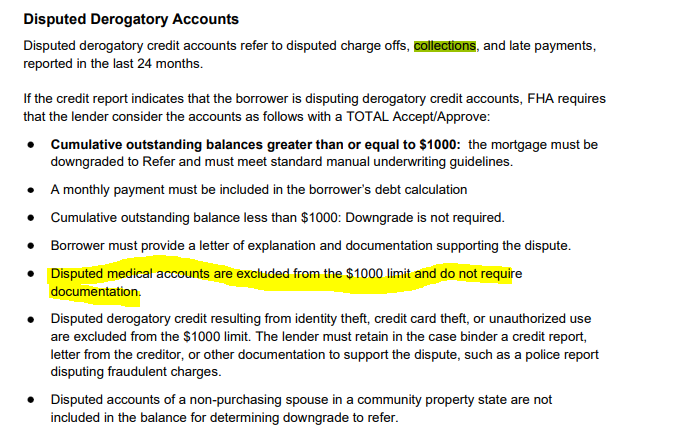
    3.           Handling of Disputed AccountsThe existence of potentially inaccurate information on a borrower's credit report resulting in a dispute must be reviewed by an underwriter. Accounts that appear as disputed on the borrower's credit report are not considered in the credit score utilized by TOTAL Mortgage Scorecard in rating the application. Therefore, FHA requires the lender to consider them in the underwriting analysis as described below.
With this ML, FHA is revising policy on manual downgrades for applications with disputed accounts to reflect the risk associated with derogatory and non-derogatory disputed accounts for factors such as age and size of outstanding balance.
Disputed Derogatory Accounts Indicated on the Credit Report - If the credit report utilized by TOTAL Mortgage Scorecard indicates that the borrower is disputing derogatory credit accounts, the borrower must provide a letter of explanation and documentation supporting the basis of the dispute. The lender must analyze the documentation provided for consistency with other credit information in the file to determine if the derogatory credit account should be considered in the underwriting analysis.
Guidance for TOTAL Mortgage Scorecard Accept/Approve loans with disputed accounts.
Disputed Derogatory Credit Accounts greater than or equal to $1,000
If the cumulative outstanding balance of disputed derogatory credit accounts of all borrowers is equal to or greater than $1,000, the mortgage application must be downgraded to a"Refer" and a Direct Endorsement underwriter is required to manually underwrite the loan as described above.
Disputed Derogatory Credit Accounts less than $1,000
If the cumulative outstanding balance of disputed derogatory credit accounts of all borrowers is less than $1,000, a downgrade is not required.
Excluded Accounts
  • Disputed medical accounts are excluded from the $1,000 limit and do not require documentation.
  • Disputed derogatory credit accounts resulting from identity theft, credit card theft, or unauthorized use are also excluded from the $1,000 limit. However, the lender must provide in the case binder a credit report, letter from the creditor, or other appropriate documentation to support the dispute, such as a police report disputing the fraudulent charges.
Disputed derogatory credit accounts are defined as follows:
  • disputed charge-off accounts,
  • disputed collection accounts, and
  • disputed accounts with late payments in the last 24 months.

Disputed derogatory credit accounts of a non-purchasing spouse in a community property state are not included in the cumulative balance for determining if the mortgage application is downgraded to a "Refer".
Non-derogatory disputed accounts are excluded from the $1,000 cumulative total.
Non-Derogatory Disputed Accounts and Disputed Accounts Not Indicated on the Credit Report - Non-derogatory disputed accounts include the following types of accounts:
  • disputed accounts with zero balance,
  • disputed accounts with late payments aged 24 months or greater, and
  • disputed accounts that are current and paid as agreed.
 If a borrower is disputing non-derogatory accounts, or is disputing accounts which are not indicated on the credit report as being disputed, the lender is not required to downgrade the application to a "Refer." However, the lender must analyze the effect of the disputed accounts on the borrower's ability to repay the loan. If the dispute results in the borrower's monthly debt payments utilized in computing the debt-to-income ratio being less than the amount indicated on the credit report, the borrower must provide documentation of the lower payments.
If you have loans pending that these changes will affect, be sure to order the FHA case number prior to October 15, 2013.

Disputed Accounts On Credit Report and how it effects FHA Loans


Apply For FHA Mortgage Loan in Kentucky


-- 
Joel Lobb (NMLS#57916)
Senior  Loan Officer
502-905-3708 cell
kentuckyloan@gmail.com

Fill out my form for mortgage pre-approval by clicking this link!

Kentucky FHA Mortgage Information

Louisville Kentucky Mortgage Lender for FHA, VA, KHC, USDA and Rural Housing Kentucky Mortgages: Kentucky FHA Mortgage Information


 How to Qualify For a Kentucky FHA Mortgage Loan 1. Low Down Payment   –  FHA Mortgage Loans only require a 3.5% down payment. And what m...

How to Qualify For a Kentucky FHA Mortgage Loan


Kentucky FHA Mortgage Loans 2026 | FHA Lender Requirements for First-Time Buyers

Kentucky FHA loan limits for 2026: county coverage, requirements, and FHA vs conventional

FHA loan limits set the maximum mortgage amount the Federal Housing Administration will insure. These limits directly affect how much Kentucky homebuyers can borrow using FHA financing and help set realistic expectations when purchasing a home.

For 2026, the Department of Housing and Urban Development increased FHA loan limits nationwide due to continued home price appreciation. The new limits apply to FHA case numbers assigned on or after January 1, 2026.

2026 FHA loan limits in Kentucky (all counties)

All 120 Kentucky counties fall under the standard FHA floor limits for 2026. There are no high-cost county exceptions in Kentucky.

  • 1-unit (single-family): $541,287
  • 2-unit: $693,050
  • 3-unit: $837,700
  • 4-unit: $1,041,125

These limits apply to FHA purchase and refinance transactions when FHA credit, income, and underwriting requirements are met.

Kentucky FHA loan limits by county (2026)

Every Kentucky county listed below uses the same FHA loan limits for 2026:

Adair, Allen, Anderson, Ballard, Barren, Bath, Bell, Boone, Bourbon, Boyd, Boyle, Bracken, Breathitt, Breckinridge, Bullitt, Butler, Caldwell, Calloway, Campbell, Carlisle, Carroll, Carter, Casey, Christian, Clark, Clay, Clinton, Crittenden, Cumberland, Daviess, Edmonson, Elliott, Estill, Fayette, Fleming, Floyd, Franklin, Fulton, Gallatin, Garrard, Grant, Graves, Grayson, Green, Greenup, Hancock, Hardin, Harlan, Harrison, Hart, Henderson, Henry, Hickman, Hopkins, Jackson, Jefferson, Jessamine, Johnson, Kenton, Knott, Knox, Larue, Laurel, Lawrence, Lee, Leslie, Letcher, Lewis, Lincoln, Livingston, Logan, Lyon, McCracken, McCreary, McLean, Madison, Magoffin, Marion, Marshall, Martin, Mason, Meade, Menifee, Mercer, Metcalfe, Monroe, Montgomery, Morgan, Muhlenberg, Nelson, Nicholas, Ohio, Oldham, Owen, Owsley, Pendleton, Perry, Pike, Powell, Pulaski, Robertson, Rockcastle, Rowan, Russell, Scott, Shelby, Simpson, Spencer, Taylor, Todd, Trigg, Trimble, Union, Warren, Washington, Wayne, Webster, Whitley, Wolfe, Woodford

Kentucky FHA loan requirements for 2026

Credit score

Most Kentucky FHA lenders require a minimum credit score of 580 to qualify for the 3.5% down payment option. Borrowers with scores between 500 and 579 may qualify with a 10% down payment, subject to lender overlays.

Down payment

The minimum down payment is 3.5% with qualifying credit. Funds may come from savings, documented gifts, retirement accounts (with restrictions), or Kentucky down payment assistance programs.

Debt-to-income ratio

FHA guidelines typically allow up to 31% housing DTI and 43% total DTI. With strong compensating factors, approvals up to 45.99 on front end ratio and 56.9% DTI may be possible on the backend ratio.

Income and employment

Borrowers must show a two-year employment history with verifiable income. Self-employed borrowers generally need two years of tax returns.

Property requirements

The home must be owner-occupied and meet FHA minimum property standards. Eligible properties include single-family homes, FHA-approved condominiums, townhomes, and 2- to 4-unit properties where the borrower occupies one unit.

FHA mortgage insurance (MIP)

Upfront mortgage insurance premium

FHA charges an upfront mortgage insurance premium of 1.75% of the loan amount, typically financed into the loan.

Annual mortgage insurance premium

Annual FHA mortgage insurance is paid monthly and is commonly 0.55% for borrowers putting down 3.5%. FHA mortgage insurance generally remains for the life of the loan unless refinanced.

FHA vs conventional loan limits in 2026

  • FHA loan limit in Kentucky (1-unit): $541,287
  • Conventional conforming loan limit (baseline): $832,750

FHA loans are often chosen for lower down payment needs and more flexible credit standards. Conventional loans may offer higher loan limits and cancellable PMI for borrowers with stronger credit profiles.

2026 mortgage loan limits for Kentucky (conventional, FHA, VA, USDA)

Mortgage loan limits affect how much homebuyers in Kentucky can borrow using different loan programs. These limits are set annually by federal agencies and vary by loan type, property type, and county.

For 2026, Kentucky remains a standard-cost state, meaning all 120 counties use the national baseline loan limits with no high-cost county adjustments.

Published December 12, 2025
By Joel Lobb, Mortgage Broker FHA, VA, KHC, USDA


Kentucky loan limits overview for 2026

  • Total counties in Kentucky: 120
  • High-cost counties: None
  • Maximum conforming limit statewide: $832,750

2026 Kentucky baseline loan limits

The table below shows the standard 2026 loan limits that apply to all Kentucky counties.

Loan Type 1 Unit 2 Units 3 Units 4 Units
Conventional $832,750 $1,066,250 $1,288,800 $1,601,750
FHA $541,287 $693,050 $837,700 $1,041,125
VA $832,750* $1,066,250* $1,288,800* $1,601,750*
USDA No loan limit** Not eligible Not eligible Not eligible

* VA loans do not have a formal loan limit for eligible veterans with full entitlement, but these figures align with conforming loan thresholds.
** USDA loans do not have loan limits. USDA eligibility is based on household income limits and property location in designated rural areas.

Important USDA clarification (this matters)

USDA loans are often misunderstood. There is no maximum loan amount set by USDA. Instead, approval is based on:

  • Household income limits (based on county and household size)
  • Debt-to-income ratios
  • Property eligibility in USDA-designated rural areas

Any source listing a fixed USDA loan limit (such as $433,020) is incorrect.

Kentucky mortgage market insight

Kentucky continues to offer affordable housing compared to national averages. The majority of buyers remain well within conforming loan limits, and jumbo loans are uncommon statewide.

For most Kentucky buyers, FHA, VA, USDA, and conventional conforming loans remain the primary financing options in 2026.

How to use Kentucky loan limits

1. Identify your loan program

Each loan type has different rules. FHA limits are lower but allow smaller down payments. Conventional loans offer higher limits for buyers with stronger credit. VA and USDA loans focus more on eligibility than loan size.

2. Match limits to affordability

Loan limits do not equal approval amounts. Income, credit, debts, and monthly payment comfort matter more than the maximum number.

3. Get pre-approved early

A Kentucky-based lender can review your full financial picture and confirm which loan type fits best before you shop for a home.

Kentucky county loan limits

All Kentucky counties use the same 2026 baseline limits:

Adair, Allen, Anderson, Ballard, Barren, Bath, Bell, Boone, Bourbon, Boyd, Boyle, Bracken, Breathitt, Breckinridge, Bullitt, Butler, Caldwell, Calloway, Campbell, Carlisle, Carroll, Carter, Casey, Christian, Clark, Clay, Clinton, Crittenden, Cumberland, Daviess, Edmonson, Elliott, Estill, Fayette, Fleming, Floyd, Franklin, Fulton, Gallatin, Garrard, Grant, Graves, Grayson, Green, Greenup, Hancock, Hardin, Harlan, Harrison, Hart, Henderson, Henry, Hickman, Hopkins, Jackson, Jefferson, Jessamine, Johnson, Kenton, Knott, Knox, Larue, Laurel, Lawrence, Lee, Leslie, Letcher, Lewis, Lincoln, Livingston, Logan, Lyon, McCracken, McCreary, McLean, Madison, Magoffin, Marion, Marshall, Martin, Mason, Meade, Menifee, Mercer, Metcalfe, Monroe, Montgomery, Morgan, Muhlenberg, Nelson, Nicholas, Ohio, Oldham, Owen, Owsley, Pendleton, Perry, Pike, Powell, Pulaski, Robertson, Rockcastle, Rowan, Russell, Scott, Shelby, Simpson, Spencer, Taylor, Todd, Trigg, Trimble, Union, Warren, Washington, Wayne, Webster, Whitley, Wolfe, Woodford


Published by Joel Lobb, Mortgage Broker FHA, VA, KHC, USDA
Helping Kentucky homebuyers navigate loan limits and financing options with clarity.

Helpful Kentucky homebuyer resources


Published by Joel Lobb, Mortgage Broker FHA, VA, KHC, USDA

Kentucky FHA Job Gap Guidelines Explained

Kentucky FHA Job Gap Guidelines: Qualify With Employment Gaps

Kentucky FHA Job Gap Guidelines: What Borrowers Need to Know

Are you worried that a job change or period of unemployment will disqualify you from getting an FHA loan in Kentucky? You're not alone. Many first-time homebuyers assume that any employment gap means instant rejection. The good news: FHA's rules are far more flexible than most people realize.

This comprehensive guide covers everything Kentucky homebuyers need to know about FHA job gap requirements, employment stability standards, and how to document your income history to qualify for an FHA mortgage.


FHA's Two-Year Employment Requirement: What It Really Means

One of the biggest misconceptions about FHA loans is that you must work for the same employer for two full years. This simply isn't true.

FHA doesn't require employment continuity with a single employer. Instead, mortgage lenders verify your overall employment and income stability over the past 24 months. This means FHA evaluators look at the complete picture of your work history, not just tenure at one job.

When reviewing your employment history, FHA-approved lenders examine:

  • Job changes and transitions between employers
  • Periods of unemployment or gaps in employment
  • Changes in industry, career field, or job title
  • Income patterns, consistency, and growth over time
  • Explanation letters for any breaks in employment

Even minor gaps—sometimes just one month—typically require written explanation from the borrower. This documentation helps lenders understand the context behind employment interruptions and assess your likelihood of continued income.


FHA Job Gaps Longer Than Six Months: How They're Evaluated

A job gap lasting six months or longer does trigger additional FHA scrutiny, but it doesn't automatically disqualify you. FHA guidelines allow your income to be counted for qualifying purposes as long as two key conditions are met:

  • Return to stable employment: You must have been back to work for at least six months in your current position or in a similar line of work
  • Prior work history: You can demonstrate a stable two-year employment history before the gap occurred

The types of employment history that count toward this requirement include:

  • Traditional W-2 employment with previous employers
  • Industry-specific training or apprenticeships
  • Educational programs and vocational certifications
  • Military service (full or part-time)
  • Self-employment in your field

The key principle is demonstrating that you have a consistent pattern of work and income—with a reasonable explanation for the interruption.


Acceptable Reasons for Employment Gaps in FHA Underwriting

FHA underwriters understand that real life happens. The program was created to help working families, including those with imperfect employment histories. FHA permits and accepts employment gaps for the following reasons:

  • Job loss: Layoffs, company closures, or reductions in force
  • Medical hardship: Illness, injury, or recovery requiring time away from work
  • Family leave: Parental leave, childcare responsibilities, or family caregiving
  • Education and training: Pursuit of certifications, degrees, or vocational training
  • Seasonal employment: Natural gaps in seasonal, cyclical, or project-based work
  • Military service: Active duty, reserve service, or transition periods
  • Relocation: Job search during a move to a new geographic area

What matters most is that you can document the reason for the gap and demonstrate that you've returned to stable, ongoing employment. Your current job should show signs of stability and reasonable likelihood of continuation.


How FHA Treats Variable and Irregular Income

Not all income is earned the same way. Certain income sources fluctuate by nature, so FHA requires longer documentation periods to prove they're reliable.

FHA allows lenders to count the following variable income types toward your qualifying income:

  • Overtime pay
  • Bonus compensation
  • Commission-based earnings
  • Part-time employment
  • Seasonal work
  • Freelance or contract income

The requirement: You must show at least 24 months of consistent history with this income type. Alternatively, if you have strong evidence that this income is expected to continue—such as a new employment contract or documented growth trend—lenders may use shorter history periods.

For example, if you earn significant commission income, your lender will review your past two years of tax returns and pay stubs to calculate an average. If the average is stable or increasing, it typically qualifies for your mortgage application.


Self-Employment and FHA Job Gap Rules

Self-employed borrowers face somewhat stricter requirements because business income can be variable and subject to change. Typically, FHA requires a minimum two-year history of self-employment to use business income for qualifying.

However, FHA does allow exceptions if:

  • You previously worked in the same field before becoming self-employed, or
  • You completed formal education, training, or apprenticeship directly related to your business before launching it

When evaluating self-employment income, FHA lenders review:

  • Two years of complete federal tax returns (1040 with Schedule C)
  • Year-to-date profit and loss statements
  • Evidence of business stability and positive cash flow
  • Professional assessment of whether the business will likely continue

Self-employed borrowers should maintain organized business records and be prepared to explain their business model and income projections during the FHA application process.


Does FHA Require Two Years With the Same Employer? No.

This myth persists among homebuyers, but it's simply not true. Let's clear up what FHA actually requires versus common misconceptions:

FHA Does NOT Require:

  • Two consecutive years working for the same employer
  • Two years in the same job title or position
  • Two years of full-time employment only
  • Zero employment gaps or job changes

FHA DOES Require:

  • A verifiable two-year work history (with documented explanations for gaps)
  • Current employment that's stable and likely to continue
  • Demonstrated income stability and consistency
  • Reasonable likelihood that you'll continue earning current income

The focus is on stability and income continuity, not rigid employment tenure. Job changes are normal, and FHA recognizes this. As long as you can explain your employment moves and show stable income, you'll likely qualify.


Kentucky FHA Borrowers: What You Need to Qualify With a Job Gap

If you've experienced job changes, periods of unemployment, or employment transitions, you can still qualify for an FHA loan in Kentucky. Use this checklist to ensure you're prepared:

  • Document every gap: Have a written explanation for any employment interruption, even brief ones
  • Verify your stability: Show that you're currently employed in a stable position
  • Follow the six-month rule: If your gap was longer than six months, ensure you've been back to work for at least six months
  • Build your history: Demonstrate a solid two-year work history prior to any long gap
  • Gather supporting documents: Prepare pay stubs, W-2 forms, offer letters, and employment verification letters

FHA loans exist to help real working people achieve homeownership—not just those with perfect employment records. With proper documentation and stable current employment, employment gaps won't derail your path to homeownership in Kentucky.


Ready to Apply for a Kentucky FHA Mortgage?

If you have employment gaps, job changes, or variable income and want to explore FHA financing, I can provide a personalized review of your situation and qualifying options.

As a mortgage specialist focused on Kentucky first-time homebuyers for over 20 years, I've helped more than 1,300 families qualify for FHA loans—many with complex employment histories. I can guide you through the documentation process and connect you with loan programs designed to fit your specific circumstances.

Contact me today for a free, no-obligation FHA eligibility review:

Joel Lobb

Mortgage Loan Officer – FHA, VA, USDA & KHC Specialist

NMLS Personal ID: 57916 | Company NMLS ID: 1738461

πŸ“§ Email: kentuckyloan@gmail.com

πŸ“ž Phone/Text: (502) 905-3708

🌐 www.mylouisvillekentuckymortgage.com

Equal Housing Lender | Independent platform providing expert mortgage guidance to Kentucky homebuyers

FHA Job Gap Infographics

FHA's 2-Year Employment Requirement

Understanding the Timeline: What FHA Actually Looks At

24m
Today
Current Employment
12m
12 Months Ago
Job History Review
24m
24 Months Ago
Full 2-Year Period

FHA Reviews: Overall employment stability over 24 months, NOT continuous employment with one employer

The 6-Month Rule for Job Gaps

When Employment Gaps Longer Than 6 Months Apply

6+ Months

Employment Gap

You Can Still Qualify If:

  • Back to work for at least 6 months
  • Current job is stable
  • 2-year history before the gap
  • Can explain the gap reason
  • Reasonable income expectations

Acceptable Reasons for Employment Gaps

FHA Understands Life Happens

πŸ“‰

Job Loss

Layoffs, company closures, or reduction in force

πŸ₯

Medical Issues

Illness, injury, or recovery time

πŸ‘Ά

Family Leave

Parental leave or childcare responsibilities

πŸŽ“

Education

Certifications, degrees, or training programs

🌾

Seasonal Work

Cyclical or seasonal employment gaps

πŸͺ–

Military Service

Active duty or transition periods

Variable Income Types FHA Accepts

Earn Different Ways? FHA Has You Covered

⏰ Overtime

24-month history

πŸ’° Bonuses

24-month history

πŸ“Š Commission

24-month history

πŸ• Part-Time

24-month history

🌾 Seasonal

24-month history

πŸ’Ό Freelance

24-month history

All variable income types require consistent 24-month documentation or strong evidence of continuation

FHA Job Gap Myths vs Reality

Stop Believing These Common Misconceptions

❌ FHA Myths

  • You need 2 years with same employer
  • Any gap disqualifies you
  • You can't have job changes
  • Only full-time work counts
  • Perfect employment history required

✓ FHA Reality

  • 2-year work history (any employers)
  • Gaps OK if documented & explained
  • Job changes are normal & acceptable
  • Part-time & variable income OK
  • Real-world work history accepted

Example: How FHA Views Your Employment History

A Real-World Scenario

24 Months Lookback:
Job 1: 10mo
Gap: 2mo
Job 2: 10mo

✓ FHA Says: "This applicant has solid employment history with a minor gap. The gap is explained, and they're currently stable. APPROVED."

Qualification Checklist for Kentucky FHA Borrowers

Get Ready to Apply

✓ Are You Ready?

  • Documentation: Written explanations for all employment gaps (even brief ones)
  • Stability Proof: Evidence of current stable employment
  • 6-Month Rule: If gap was 6+ months, you've been back to work 6+ months
  • History: Solid 2-year work history before any long gaps
  • Documents: Pay stubs, W-2s, offer letters, verification letters ready
  • Income Calculation: 24-month average for variable income documented

How much income do I need qualify for Kentucky Home Loan?

DTI Ratio Guide: How Much Income Do You Need for a Mortgage in Kentucky?

Mortgage DTI Ratio Guide: How Much Income Do You Need To Qualify In Kentucky?

A practical Kentucky-focused guide to debt-to-income ratios, front-end and back-end limits, and how FHA, VA, USDA, KHC, and Conventional lenders calculate what you qualify for.

Understanding How Lenders Look At Your Income In Kentucky

When you apply for a mortgage in Kentucky, lenders look past the sales price and interest rate. They want to know how much of your monthly income is already spoken for. That is where your debt-to-income ratio, or DTI, comes in.

Your DTI ratio compares your total monthly debt payments to your gross monthly income. It is one of the biggest drivers of approval, loan amount, and pricing for FHA, VA, USDA, KHC, and Conventional loans.

Key idea: a strong DTI can offset a mid-range credit score, but a weak DTI can kill a file even with great credit.

What Is Debt-To-Income (DTI) And Why It Matters

Debt-to-income ratio is the percentage of your gross monthly income that goes toward required monthly debt payments. Lenders use it to measure whether you can safely take on a new mortgage payment on top of your existing obligations.

Formula:

Total monthly debt payments ÷ gross monthly income × 100 = DTI percentage

Example: if you earn 5,000 per month and have 2,000 in total monthly debt (including the new house payment), your DTI is 40 percent.

Front-End Versus Back-End DTI Ratios

Lenders run two separate DTI tests on every file: the front-end ratio and the back-end ratio.

Front-end ratio (housing ratio)

Measures how much of your gross monthly income goes only to the house payment:

  • Principal
  • Interest
  • Property taxes
  • Homeowners insurance
  • Mortgage insurance, if applicable

For FHA, a typical guideline is around 31 percent of gross income.

Back-end ratio (total DTI)

Measures all required monthly debts including the new house payment:

  • New mortgage payment (PITI)
  • Credit card minimums
  • Auto loans
  • Student loans
  • Child support or alimony
  • Personal loans and 401(k) loans

Utilities, cell phone, car insurance, groceries, and streaming services do not count in DTI.

Most Kentucky lenders want to see a total DTI in the low-to-mid forties. Some programs will stretch higher with strong credit, savings, or residual income.

Typical DTI Guidelines By Loan Program In Kentucky

Exact approval limits come from automated underwriting findings, but these ranges are a realistic working grid for Kentucky files.

Loan program Front-end Back-end Notes
FHA Around 31 percent 43–50 percent with AUS and compensating factors Popular for first-time buyers and mid-range credit scores.
VA No strict front-end; 41 percent used as a guide 41–55 percent depending on residual income Zero down, no monthly mortgage insurance; residual income is critical.
USDA About 29–32 percent Around 41–43 percent Zero down for eligible rural areas; tighter on DTI than FHA.
KHC Around 31–32 percent 43–45 percent depending on program Used with FHA, VA, USDA, or Conventional plus down payment assistance.
Conventional (Fannie/Freddie) Around 28 percent Up to 49.9 percent with strong AUS approval Best pricing for well-qualified borrowers with solid credit.

Automated Findings Versus Manual Underwriting

Most Kentucky loans run through automated underwriting systems such as Desktop Underwriter, Loan Product Advisor, or USDA and VA equivalents. These engines have hard-coded DTI caps that cannot flex.

When a file is strong overall but just outside the automated DTI box, a manual underwriter can sometimes step in and approve the loan by looking at the full picture.

Automated underwriting (AUS)

  • Fast decisions based on credit, DTI, assets, and property data
  • DTI limits are strict; the engine cannot use judgment
  • Ideal for clean, well-qualified files

Manual underwriting

  • Human underwriter reviews the full story
  • Can allow higher DTIs with strong compensating factors
  • Common on FHA, VA, USDA, and some KHC loans

Manual underwriting is often the difference between a denial and an approval for borrowers who are a few points over standard DTI limits but have stable income, cash reserves, or strong payment history.

Residual Income And Disposable Cash Flow

DTI is not the only way to look at risk. Some programs, especially VA, put heavy weight on residual income, which is the money left over after all debts, taxes, and basic living expenses are paid.

Strong residual income can tip a borderline DTI file into an approval because it shows the borrower has room to absorb surprises, repairs, and lifestyle costs beyond the minimum debt obligations.

Kentucky DTI Mortgage Calculator

Use this quick calculator to estimate the maximum monthly mortgage payment you can carry under common Kentucky guidelines. This is a rough planning tool, not a final approval decision.

Include car loans, credit cards, student loans, child support, and other required payments.

Results

Enter your income and debts to estimate how much house payment fits typical DTI rules.

This tool is for educational estimates only and is not a credit decision. Actual approvals follow AUS findings and full underwriting review.

Practical Ways To Improve Your DTI Before You Apply

If your current DTI is on the high side, a few focused moves can open up more approval options and price ranges.

Pay down or eliminate small monthly debts

Target revolving credit cards and small installment loans first. Every 50 to 100 dollars in monthly payment reduction directly lowers your DTI and raises what you qualify for.

Avoid taking on new debt before closing

New car loans, furniture financing, or large credit card purchases right before or during the mortgage process can push your DTI over the limit and cost you the approval.

Consider a co-borrower with income and low debt

A spouse or co-borrower with strong income and minimal monthly obligations can materially improve the combined DTI on the file. Their debts count too, so the profile has to make sense overall.

Look at program fit instead of forcing one product

A file that is tight for Conventional may be completely workable under FHA, VA, USDA, or KHC guidelines. Matching income, credit, and DTI to the right program is where an experienced local loan officer earns their keep.

Real Kentucky Example: 5,000 Monthly Income And 1,000 In Debts

Here is a simple FHA-style scenario for a borrower in Kentucky earning 5,000 per month with 1,000 in monthly debts on the credit report.

Item Calculation Amount
Gross monthly income Stated 5,000
Front-end limit (31 percent) 5,000 × 0.31 1,550
Back-end limit (43 percent) 5,000 × 0.43 2,150
Existing debts Car, cards, student loans 1,000
Back-end room for house payment 2,150 − 1,000 1,150
Estimated maximum PITI payment Lower of 1,550 and 1,150 1,150 per month

Depending on rate, taxes, and insurance, a payment in this range might support a price point somewhere around the high 100s to low 200s in many Kentucky markets. Exact numbers require a full quote.

Want To Know Exactly How Much House You Qualify For In Kentucky?

A quick pre-approval conversation can take the guesswork out of DTI. We can run your income, debts, and credit through multiple Kentucky lenders and programs and show you real numbers instead of rough estimates.

FHA, VA, USDA, KHC, and Conventional options available. First-time homebuyers welcome.

Joel Lobb • Mortgage Loan Officer • Expert on Kentucky Mortgage Loans

EVO Mortgage • Company NMLS 1738461 • Personal NMLS 57916 • Equal Housing Lender

This content is for educational purposes only and is not a commitment to lend. All loans are subject to credit approval, underwriting guidelines, and property acceptance. DTI guidelines and program terms are subject to change.