Using a Pastor / Minister’s housing Clergy Income for A Mortgage Loan Approval

Using a Pastor / Minister’s housing allowance to qualify for a mortgage


Member of the Clergy Income for A Mortgage Loan Approval 


Where a borrower is a member of the clergy, all of the following will be required to document income: 1) Most recent year full tax return, 2) Most recent pay stubs, 3) W-2s, 4) Contract from the church to determine benefits.

The IRS looks at the housing allowance portion of a pastor’s income as an exclusion from income.  Therefore the housing allowance is not reported on the personal tax returns as taxable income.  Even though it is not reported on the tax returns, a pastor’s housing allowance can be used in qualifying for a mortgage loan to purchase or refinance a home. 

 As long as we can document the receipt of the housing income through a signed letter from the church/employer stating the actual breakdown of the pay and by providing copies of the checks received, we should be able to count the housing allowance as income.  Some employers will even put the housing allowance on the w2 as a nontaxable amount which makes it even easier. 


See guidelines below:


Housing or Parsonage Allowance A non-military housing or parsonage allowance may be considered qualifying income, if the income has been received for the most recent 12 months. The housing allowance may not be used to offset the monthly housing payment. All of the following income documentation is required:

 Written Verification of Employment, letter from employer, or paystubs reflecting the amount of the housing or parsonage allowance
 Terms under which the housing or parsonage allowance is paid.
 Proof of receipt of housing allowance for most recent 12 months. 

Housing or Parsonage allowance may be considered as qualifying income if there is documentation that the income has been received for the most recent 12 months and the allowance is likely to continue for the next three years. 


Member of the Clergy Income for A Mortgage Loan Approval 


Where a borrower is a member of the clergy, all of the following will be required to document income: 1) Most recent year full tax return, 2) Most recent pay stubs, 3) W-2s, 4) Contract from the church to determine benefits.

The IRS looks at the housing allowance portion of a pastor’s income as an exclusion from income.  Therefore the housing allowance is not reported on the personal tax returns as taxable income.  Even though it is not reported on the tax returns, a pastor’s housing allowance can be used in qualifying for a mortgage loan to purchase or refinance a home. 

 As long as we can document the receipt of the housing income through a signed letter from the church/employer stating the actual breakdown of the pay and by providing copies of the checks received, we should be able to count the housing allowance as income.  Some employers will even put the housing allowance on the w2 as a nontaxable amount which makes it even easier. 


See guidelines below:


Housing or Parsonage Allowance A non-military housing or parsonage allowance may be considered qualifying income, if the income has been received for the most recent 12 months. The housing allowance may not be used to offset the monthly housing payment. All of the following income documentation is required:

 Written Verification of Employment, letter from employer, or paystubs reflecting the amount of the housing or parsonage allowance
 Terms under which the housing or parsonage allowance is paid.
 Proof of receipt of housing allowance for most recent 12 months. 

Housing or Parsonage allowance may be considered as qualifying income if there is documentation that the income has been received for the most recent 12 months and the allowance is likely to continue for the next three years. 


Using a Pastor / Minister’s housing Clergy Income for A Mortgage Loan Approval


http://www.emailmeform.com/builder/form/0bfJs9b6bK8TGoc6mQk9hIu


1 - πŸ“… Email - kentuckyloan@gmail.com 
2.  πŸ“ž Call/Text - 502-905-3708

Joel Lobb
Mortgage Loan Officer - Expert on Kentucky Mortgage Loans


🌐 Websitewww.mylouisvillekentuckymortgage.com
🏒 Address911 Barret Ave., Louisville, KY 40204


Evo Mortgage
Company NMLS# 1738461
Personal NMLS# 57916


Why Your Credit Score Matters for a Kentucky Mortgage | FHA, VA, USDA, K...

FHA CHANGES TO HANDLING OF COLLECTIONS, JUDGEMENTS AND DISPUTED ACCOUNTS ON CREDIT REPORT


FHA CHANGES TO HANDLING OF COLLECTIONS
AND DISPUTED ACCOUNTS


FHA recently released Mortgagee Letters 2013-24 and 2013-25, to amend guidance on collections and disputed accounts and to clarify guidance on judgments. These changes will become effective for all case numbers assigned on or after October 15, 2013. This will apply to all FHA programs, with the exception of non-credit qualifying streamline refinances and Home Equity Conversion Mortgages. The changes are found below. Should you have any questions, please contact your Account Manager.
1.           Credit Analysis of Collections and Judgments. Collections and judgments may indicate a borrower's disregard for credit obligations and must be considered in the creditworthiness analysis. The guidance below applies to loans with collection accounts and all judgments. Medical collections and charge off accounts are excluded from this guidance.
  • Applicable to Manually Underwritten Loans: The lender must document reasons for approving a mortgage when the borrower has collection accounts or judgments.
Regardless of the amount of outstanding collection accounts or judgments, the lender must determine if the collection account or judgment was a result of:
    • The borrower's disregard for financial obligations;
    •  The borrower's inability to manage debt; or
    • Extenuating circumstances.
The borrower must provide a letter of explanation with supporting documentation for each outstanding collection account and judgment. The explanation and supporting documentation must be consistent with other credit information in the file.
  • Applicable to Loans Run Through TOTAL Mortgage Scorecard: TOTAL Mortgage Scorecard Accept/Approve - There are no documentation or letter of explanation requirements for loans with collection accounts or judgments run through TOTAL Mortgage Scorecard receiving an "Accept/Approve" despite the presence of collection accounts or judgments. These accounts have been already taken into consideration in the borrower's credit score. If TOTAL Mortgage Scorecard generates a"Refer," the lender must manually underwrite the loan in accordance with the guidance above applicable to manually underwritten loans with collection accounts and judgments. 
All medical collections and charge off accounts are excluded from this guidance and do not require resolution.
Collections - FHA does not require collection accounts to be paid off as a condition of mortgage approval. However, FHA does recognize that collection efforts by the creditor for unpaid collections could affect the borrower's ability to repay the mortgage. To mitigate this risk, FHA is requiring a capacity analysis of collection accounts with an aggregate balance equal to or greater than $2,000, as described below.
If the total outstanding balance of all collection accounts for all borrowers is equal to or greater than $2,000, the lender must perform a capacity analysis as detailed below. Unless excluded under state law, collection accounts of a non-purchasing spouse in a community property state are included in the cumulative balance.
All medical collections and charge off accounts are excluded from this guidance and do not require resolution.
Capacity analysis includes any of the following actions:
  • At the time of or prior to closing, payment in full of the collection account (verification of acceptable source of funds required).
  • The borrower makes payment arrangements with the creditor. If the borrower has entered into a payment arrangement with the creditor, a credit report or letter from the creditor verifying the monthly payment is required. The monthly payment must be included in the borrower's debt-to-income ratio.
  • If evidence of a payment arrangement is not available, the lender must calculate the monthly payment using 5% of the outstanding balance of each collection, and include the monthly payment in the borrower's debt-to-income ratio.
TOTAL Mortgage Scorecard Accept/Approve/Refer - Regardless of the Accept/Approve/Refer recommendation by TOTAL Mortgage Scorecard, the lender must include the payment amount in the calculation of the borrower's debt-to-income ratio.
               Judgments - FHA requires judgments to be paid off before the mortgage loan is eligible for FHA insurance. An exception to the payoff of a court ordered judgment may be made if the borrower has an agreement with the creditor to make regular and timely payments. The borrower must provide a copy of the agreement and evidence that payments were made on time in accordance with the agreement, and a minimum of three months of scheduled payments have been made prior to credit approval.
Borrowers are not allowed to prepay scheduled payments in order to meet the required minimum of three months of payments. Furthermore, lenders are instructed to include the payment amount in the agreement in the calculation of the borrower's debt-to-income ratio.
FHA requires judgments of a non-purchasing spouse in a community property state to be paid in full, or meet the exception guidance for judgments above, unless excluded by state law.
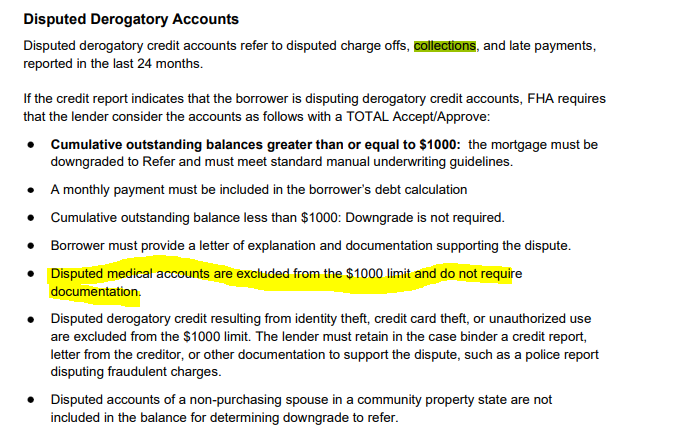
    3.           Handling of Disputed AccountsThe existence of potentially inaccurate information on a borrower's credit report resulting in a dispute must be reviewed by an underwriter. Accounts that appear as disputed on the borrower's credit report are not considered in the credit score utilized by TOTAL Mortgage Scorecard in rating the application. Therefore, FHA requires the lender to consider them in the underwriting analysis as described below.
With this ML, FHA is revising policy on manual downgrades for applications with disputed accounts to reflect the risk associated with derogatory and non-derogatory disputed accounts for factors such as age and size of outstanding balance.
Disputed Derogatory Accounts Indicated on the Credit Report - If the credit report utilized by TOTAL Mortgage Scorecard indicates that the borrower is disputing derogatory credit accounts, the borrower must provide a letter of explanation and documentation supporting the basis of the dispute. The lender must analyze the documentation provided for consistency with other credit information in the file to determine if the derogatory credit account should be considered in the underwriting analysis.
Guidance for TOTAL Mortgage Scorecard Accept/Approve loans with disputed accounts.
Disputed Derogatory Credit Accounts greater than or equal to $1,000
If the cumulative outstanding balance of disputed derogatory credit accounts of all borrowers is equal to or greater than $1,000, the mortgage application must be downgraded to a"Refer" and a Direct Endorsement underwriter is required to manually underwrite the loan as described above.
Disputed Derogatory Credit Accounts less than $1,000
If the cumulative outstanding balance of disputed derogatory credit accounts of all borrowers is less than $1,000, a downgrade is not required.
Excluded Accounts
  • Disputed medical accounts are excluded from the $1,000 limit and do not require documentation.
  • Disputed derogatory credit accounts resulting from identity theft, credit card theft, or unauthorized use are also excluded from the $1,000 limit. However, the lender must provide in the case binder a credit report, letter from the creditor, or other appropriate documentation to support the dispute, such as a police report disputing the fraudulent charges.
Disputed derogatory credit accounts are defined as follows:
  • disputed charge-off accounts,
  • disputed collection accounts, and
  • disputed accounts with late payments in the last 24 months.

Disputed derogatory credit accounts of a non-purchasing spouse in a community property state are not included in the cumulative balance for determining if the mortgage application is downgraded to a "Refer".
Non-derogatory disputed accounts are excluded from the $1,000 cumulative total.
Non-Derogatory Disputed Accounts and Disputed Accounts Not Indicated on the Credit Report - Non-derogatory disputed accounts include the following types of accounts:
  • disputed accounts with zero balance,
  • disputed accounts with late payments aged 24 months or greater, and
  • disputed accounts that are current and paid as agreed.
 If a borrower is disputing non-derogatory accounts, or is disputing accounts which are not indicated on the credit report as being disputed, the lender is not required to downgrade the application to a "Refer." However, the lender must analyze the effect of the disputed accounts on the borrower's ability to repay the loan. If the dispute results in the borrower's monthly debt payments utilized in computing the debt-to-income ratio being less than the amount indicated on the credit report, the borrower must provide documentation of the lower payments.
If you have loans pending that these changes will affect, be sure to order the FHA case number prior to October 15, 2013.

Disputed Accounts On Credit Report and how it effects FHA Loans


Apply For FHA Mortgage Loan in Kentucky


-- 
Joel Lobb (NMLS#57916)
Senior  Loan Officer
502-905-3708 cell
kentuckyloan@gmail.com

Fill out my form for mortgage pre-approval by clicking this link!

2026 Kentucky Homebuyers Guide: Getting Approved for a Mortgage Loan in Kentucky

If you’re a Kentucky homebuyer, this updated 2026 guide walks you through the mortgage approval process from start to finish.

Whether you are buying your first home or your next home, this resource covers FHA, VA, USDA, KHC loans, down payment assistance, and available grants.

You’ll also find clear guidance on credit scores, income limits, debt-to-income ratios, work history, appraisals, inspections, bankruptcy, foreclosure rules, and realistic closing timelines.

Zero Down Payment Options for Kentucky Homebuyers in 2026

Kentucky continues to offer multiple paths to homeownership with little to no money down:

Kentucky Housing Corporation (KHC) loans

FHA loans paired with down payment assistance

VA loans for eligible veterans and active-duty service members

USDA Rural Housing loans

Federal Home Loan Bank Welcome Home Grant (when available)

Each program has different eligibility rules. The sections below break them down clearly.

Kentucky FHA Loan With KHC Down Payment Assistance

Kentucky Housing Corporation continues to offer FHA-insured loans paired with down payment assistance for qualified buyers.

Credit score: Typically 620 minimum for FHA, 660 for conventional options through KHC

Down payment: 3.5 percent (can be fully or partially offset with KHC DAP)

Income limits: Vary by county and household size See current KHC income and purchase price limits

Debt-to-income ratio: Commonly up to 50 percent depending on findings

Work history: Two years of stable, documented income

KHC Down Payment Assistance (DAP)

Most programs offer up to $12,500, repayable over 15 years. Funds may be used for down payment, closing costs, prepaid taxes, insurance, and interim interest. Program terms are subject to annual updates.

Kentucky FHA Loan With KHC Down Payment Assistance


FHA Loans in Kentucky – 2026 Guidelines

FHA loans remain one of the most flexible mortgage options in Kentucky, especially for buyers with limited savings or lower credit scores.

Credit score options:

580 and higher with 3.5 percent down

500 to 579 with 10 percent down

Debt-to-income ratio: Frequently approved up to 56.99 percent with strong compensating factors

Work history: Two years of consistent income; job changes are acceptable if income is stable

Bankruptcy and foreclosure waiting periods:

Chapter 7 bankruptcy: Two years

Chapter 13 bankruptcy: Eligible after 12 months of on-time payments with court approval

Foreclosure: Three years

Kentucky FHA Loan Limits for 2026

FHA loan limits increased again for 2026 due to rising home values.

One-unit: $541,287

Two-unit: $693,750

Three-unit: $838,450

Four-unit: $1,041,750

Kentucky VA Loans for Veterans and Active Duty

VA loans remain one of the strongest mortgage benefits available, offering zero down payment and no monthly mortgage insurance.

Certificate of Eligibility (COE) is required. Request your COE here

Credit score: No official minimum, most lenders prefer 580–620

Income: Must be stable and sufficient

Work history: Two years or military service continuity; post-service employment should align with MOS when applicable

Debt-to-income ratio: Flexible, subject to residual income requirements

Bankruptcy or foreclosure: Two-year waiting period

USDA Rural Housing Loans in Kentucky

USDA loans provide 100 percent financing for eligible rural properties across much of Kentucky.

Credit score: 640 for automated approval through GUS; manual underwriting available below 640

Income limits for 2026:πŸ‘‡πŸ‘‡

Check Kentucky USDA property eligibility

Debt-to-income ratio: 32 percent front-end, 45 percent back-end

Work history: Two years of stable income

Kentucky Down Payment Assistance and Grants – 2026 Update

The Welcome Home Grant through the Federal Home Loan Bank of Cincinnati is expected to return in March 2026. Exact grant amounts, income limits, and funding caps are announced shortly before release.

Historically, grants have offered up to $25,000 for eligible veterans and up to $20,000 for other qualified buyers. Funds are limited and typically exhausted quickly.

Ready to Get Started

Buying a home in Kentucky does not have to be confusing. With the right loan program and guidance, FHA, VA, USDA, and KHC options can make homeownership achievable in 2026.

For personalized guidance, contact:

Joel Lobb
Mortgage Loan Officer
Phone or Text: 502-905-3708
Email: kentuckyloan@gmail.com
Website: https://www.mylouisvillekentuckymortgage.com

EVO Mortgage
Company NMLS 1738461
Individual NMLS 57916


Joel Lobb, Mortgage Broker FHA, VA, KHC, USDA Reviews

★★★★★

“Joel was incredibly helpful throughout the whole process of buying a home. This was my first time, and he made everything clear and stress-free from start to finish.”

— Mike , Kentucky First-Time Homebuyer

Louisville Down Payment Assistance 2026 | Up to $25,000 Metro Housing fo...

Kentucky Credit Score Requirements for Mortgage Approval – FHA, VA, USDA, Fannie Mae & KHC

Thinking about buying or refinancing a home in Kentucky and wondering what credit score you need? Your credit score is one of the key factors lenders look at when deciding whether to approve your mortgage and what interest rate to offer.

As a Kentucky mortgage loan officer who has helped over 1,300 families across the state, I work every day with first-time homebuyers, repeat buyers and homeowners looking to refinance using programs like FHA, VA, USDA Rural Housing, Conventional (Fannie Mae) and Kentucky Housing Corporation (KHC) down payment assistance.

This guide breaks down typical credit score benchmarks for Kentucky mortgage approvals and explains what you can do if your scores are not quite where you want them yet.


Why Your Credit Score Matters for a Kentucky Mortgage

When you apply for a mortgage in Kentucky, the lender pulls your credit from the three major bureaus and uses your middle score (or the lower middle score if there is more than one borrower).

Your credit score helps the lender evaluate:

  • How likely you are to pay on time
  • Your history of managing credit cards, auto loans and other accounts
  • How much total debt you are carrying compared to your limits
  • Past issues like collections, charge-offs, bankruptcies or foreclosures

Important: There is no single “magic number” that approves or denies every Kentucky mortgage. Each program has its own guidelines, and many lenders add their own internal rules, called “overlays.” Your income, debt-to-income ratio (DTI), job stability and property type all matter too.


Typical Credit Score Minimums by Loan Type in Kentucky

Below are common credit score benchmarks used by many lenders for Kentucky borrowers. These are general guidelines and can change based on lender, market conditions and your overall profile.

Loan Type Typical Minimum Credit Score Notes for Kentucky Borrowers
FHA (Federal Housing Administration) 580+ for 3.5% down
500–579 possible with 10% down (lender approval required)
Very popular with first-time homebuyers and buyers with limited down payment or past credit issues.
VA (Department of Veterans Affairs) No official VA minimum; many lenders look for 580–620+ For eligible Veterans, Active Duty, Reservists and some surviving spouses. No monthly PMI and flexible guidelines.
USDA (Rural Housing) Often 620–640+ for automated approval $0 down for eligible rural areas in Kentucky. Lower scores may require more documentation and manual underwriting.
Conventional (Fannie Mae/Freddie Mac) Generally 620+ minimum Stronger scores (680–740+) can mean better interest rates and easier approval, especially with lower down payments.
Kentucky Housing Corporation (KHC) Varies by program; many options start around 620+ Often paired with FHA, VA, USDA or Conventional loans for down payment and closing cost assistance for Kentucky homebuyers.

Note: These are typical ranges only. Final approval depends on full underwriting and your complete financial profile.


How Your “Qualifying” Mortgage Credit Score Is Calculated

When you apply, your lender orders a tri-merge mortgage credit report from:

  • Experian
  • Equifax
  • TransUnion

For most Kentucky mortgages, the lender uses the middle score of the three bureaus as the “qualifying” score. If there are two borrowers, the lender usually uses the lower of the two middle scores.

Example:

  • Borrower A: 598, 625, 604 → Qualifying score = 604
  • Borrower B: 640, 659, 652 → Qualifying score = 652

If both apply together, the lender may qualify the file off the lower middle score, in this example 604.

Also keep in mind: mortgage lenders often use older FICO models (not the same as many “free” credit score apps), so your lender’s scores can look different from what you see on a credit monitoring website.


FHA Credit Score Requirements in Kentucky

FHA loans are a go-to option for many Kentucky first-time home buyers because they allow for lower down payments and more flexible credit guidelines than many conventional loans.

  • 580+ credit score: You may qualify for the minimum 3.5% down payment, subject to full underwriting.
  • 500–579 credit score: FHA will technically allow financing with at least 10% down, but many lenders set higher internal minimums. Expect a case-by-case review and stricter conditions.
  • Below 500: Usually not eligible for FHA financing. Work on credit repair first, then re-apply.

FHA also looks closely at your recent 12–24 month payment history, especially for any mortgage or rent, auto loans and major revolving accounts.

For more in-depth FHA information, you can also review my Louisville FHA guide here:
Louisville Kentucky First-Time Home Buyer FHA & KHC Programs


VA Credit Score Guidelines for Kentucky Veterans

The VA itself does not publish a strict minimum credit score. Instead, lenders set their own tolerances based on risk, experience and market conditions.

In practice for Kentucky VA home loans:

  • Many lenders look for 580–620+ as a baseline.
  • Stronger income, solid recent payment history and low DTI can help offset borderline scores.
  • Past credit events (bankruptcy, foreclosure, short sale) may require seasoning time and compensating factors.

VA loans can be extremely powerful tools for eligible buyers: no down payment in most cases, no monthly PMI, and flexible guidelines when structured properly.


USDA Rural Housing Credit Score Expectations in Kentucky

USDA Rural Development (Rural Housing) loans offer true $0 down financing in many areas of Kentucky. Because there is no down payment, lenders pay close attention to credit history and income stability.

Typical USDA score expectations:

  • 640+: Often qualifies for automated underwriting approval (GUS Accept), assuming the rest of the file is strong.
  • 620–639: May still be possible, but more documentation or a manual underwrite could be required.
  • Below 620: Case-by-case basis. Expect more scrutiny and a need for strong compensating factors like low DTI and reserves.

If you want to check whether a property might be USDA-eligible, you can start with my Kentucky USDA map and eligibility tools here:
Check if a Kentucky Property Is in a USDA Eligible Area


Conventional (Fannie Mae/Freddie Mac) Credit Score Benchmarks

Conventional loans backed by Fannie Mae or Freddie Mac usually require a stronger credit profile than FHA, VA or USDA.

  • 620+: Common minimum score for many lenders.
  • 660–679: Often required for certain products, lower down payments or riskier profiles.
  • 680–740+: Typically qualifies for more favorable pricing, especially with smaller down payments.

If you are trying to refinance out of FHA into a Conventional loan to remove mortgage insurance, or you want to pair a Conventional loan with KHC down payment assistance, your credit score can make a noticeable difference in interest rate and closing cost options.


How KHC (Kentucky Housing Corporation) Looks at Credit

Kentucky Housing Corporation (KHC) does not lend money directly to consumers, but it partners with approved lenders (like us) to provide down payment assistance and special programs.

In general:

  • Many KHC programs start around 620+ credit scores, depending on the specific product and loan type (FHA, VA, USDA, Conventional).
  • KHC overlays may be stricter than the underlying FHA/VA/USDA/Conventional guidelines in some areas.
  • Higher scores help with pricing, underwriting approval and access to more assistance options.

If you are a first-time homebuyer in Kentucky and need help with down payment or closing costs, we can review which KHC options fit your credit profile and income.


Refinancing vs. Purchasing: Does the Credit Score Requirement Change?

For most programs, the credit score ranges are similar whether you are purchasing or refinancing. However, the purpose of the refinance can matter:

  • Rate-and-term refinance: Often similar credit score and DTI guidelines as a purchase.
  • Cash-out refinance: Usually requires higher scores and more equity, especially for Conventional and VA cash-out.
  • Streamline refinances (FHA, VA IRRRL, etc.): May have more flexible credit documentation but still require a review of payment history and risk.

If you already own a home in Kentucky and want to lower your payment, shorten your term, or remove mortgage insurance, we can run side-by-side refinance scenarios based on your current scores.


5 Practical Ways to Improve Your Credit Before Applying

If your credit score is close to the cutoff, even a small improvement can open up better loan options and interest rates. Here are five practical steps:

  1. Pull and review your credit reports. Check Experian, Equifax and TransUnion for errors, duplicates or old derogatory items that should have fallen off.
  2. Lower your credit card balances. Try to keep utilization under 30% of your limits on each revolving account – lower is better.
  3. Avoid new loans or major purchases. Hold off on buying vehicles, furniture or opening new credit cards right before applying for a mortgage.
  4. Make every payment on time. A single 30-day late payment can drop scores and trigger underwriting issues.
  5. Talk to a Kentucky loan officer early. A customized credit review can show you which actions will give you the biggest boost toward mortgage approval.

Next Steps: Talk Through Your Kentucky Mortgage Credit Plan

Every borrower’s story is different. Two people can have the same credit score but very different credit histories and approval paths.

If you are:

  • A first-time homebuyer in Kentucky
  • Looking to refinance your current home loan
  • A Veteran or active-duty service member considering a VA loan
  • Buying in a rural area and exploring USDA Rural Housing
  • Interested in KHC down payment assistance

…I can help you review your credit, run loan scenarios and design a practical plan to get you approved.

Call or text: 502-905-3708
Email: kentuckyloan@gmail.com

Serving homebuyers and homeowners across all 120 counties in Kentucky.


Frequently Asked Questions About Kentucky Mortgage Credit Scores

What is the minimum credit score for an FHA loan in Kentucky?

Many lenders in Kentucky look for a 580+ credit score to qualify for the 3.5% minimum down payment on an FHA loan. Scores between 500 and 579 may be considered with at least 10% down, but approval is more difficult and not all lenders will allow it.

Can I get a Kentucky mortgage with a credit score below 580?

It can be possible, but options are limited. Some FHA and VA lenders may consider scores in the 500–579 range with stronger down payment, low debt-to-income ratio and clean recent payment history. In many cases, it is more effective to spend a few months improving your credit and then apply.

What credit score do I need for a VA loan in Kentucky?

The VA does not publish a hard minimum score, but many Kentucky lenders prefer 580–620+. Stronger scores can mean better terms, especially if you have prior credit challenges.

What credit score is required for a USDA Rural Housing loan in Kentucky?

USDA loans often work best with scores of 640 or higher for automated approval. Lower scores may still be considered, but expect more documentation, a manual underwrite and tighter qualification standards.

How can I improve my score quickly before applying for a Kentucky mortgage?

Common fast-impact steps include paying down credit card balances, bringing any past-due accounts current, avoiding new inquiries and disputing any obvious errors on your report. A targeted review with a Kentucky loan officer can help you focus on the items that will move your score the most.


Disclaimer: This information is for educational purposes only and does not constitute a commitment to lend. Program guidelines, credit score requirements and underwriting standards are subject to change without notice. All loans are subject to credit approval, income verification, acceptable collateral and program availability.

NMLS #57916  |  Company NMLS #1738461  |  Equal Housing Lender

How to Get Approved for a USDA Mortgage Loan in Kentucky

How to Get Approved for a USDA Mortgage Loan in Kentucky

If you are planning to buy a home in Kentucky and want a zero-down mortgage option, a USDA Rural Housing loan may be a strong fit. USDA loans are backed by the U.S. Department of Agriculture and are designed to help low-to-moderate income households purchase a primary residence in eligible rural areas of Kentucky.

Below is a practical breakdown of how USDA loan approval works in Kentucky, including credit score expectations, income limits, employment history, debt-to-income ratios, and bankruptcy or foreclosure guidelines.

  1. Credit score requirements for Kentucky USDA loans
    • USDA does not publish a hard minimum credit score, but in real-world lending a 640 or higher middle score is typically required for automated GUS approval.
    • Scores below 640 may still be eligible through manual underwriting with strong compensating factors such as stable income, reserves, or positive rental history.
    • While USDA technically allows scores down to 580, very few lenders will approve these files without strict underwriting review and higher risk pricing.
  2. USDA income eligibility in Kentucky
    • USDA counts total household income, not just the income of borrowers on the loan.
    • Household income must fall within USDA limits for the specific Kentucky county and household size.
    • Income limits change annually and must be verified using current USDA data.
  3. Employment and work history
    • Most borrowers need a two-year employment history in the same line of work.
    • Gaps may be acceptable if they are explainable and the borrower is currently employed in a stable position.
  4. Property location requirements
    • The home must be located in a USDA-eligible rural area of Kentucky.
    • Many properties outside Louisville, Lexington, and Northern Kentucky qualify, but eligibility must be verified by address.
    • USDA loans are available in most of Kentucky’s 120 counties, subject to map eligibility.
  5. Debt-to-income ratio guidelines
    • Standard USDA ratios are 29% for housing and 41% for total debt.
    • Higher ratios may be approved with an automated GUS approval or strong compensating factors.
  6. USDA income limits
    • Income limits vary by county and household size.
    • In many Kentucky rural counties, limits typically range from approximately $112,450 to $148,450 depending on family size.
    • These limits update yearly and must be verified at time of application.
  7. Eligible property types
    • USDA loans are for owner-occupied primary residences only.
    • Eligible properties include single-family homes, townhomes, and approved condominiums.
    • Investment properties and vacation homes are not allowed.
  8. Bankruptcy and foreclosure waiting periods
    • Chapter 7 bankruptcy: generally 3 years from discharge.
    • Chapter 13 bankruptcy: may be eligible after 12 months of on-time payments with court approval.
    • Foreclosure: generally 3 years from completion date.
  9. Closing timeline
    • Most Kentucky USDA loans close in approximately 30–45 days.
    • USDA loans require an additional USDA review step, which can add time if the file is not complete.
  10. Appraisal and inspections
    • A USDA appraisal is required to confirm value and property condition.
    • Termite inspections may be required depending on property type and location.
  11. GUS and manual underwriting
    • USDA uses the Guaranteed Underwriting System (GUS) to evaluate risk.
    • Files that do not receive an automated approval may still qualify through manual underwriting.

Steps to get a Kentucky USDA loan

  1. Confirm property eligibility using the USDA eligibility map.
  2. Verify household income limits for the county.
  3. Apply for pre-approval with a USDA-experienced lender.
  4. Shop for an eligible home and sign a purchase contract.
  5. Complete appraisal, underwriting, USDA approval, and closing.

USDA Guaranteed loans require a 1% upfront guarantee fee and a 0.35% annual fee, which is paid monthly. These fees are typically lower than FHA mortgage insurance and can be financed into the loan.

USDA loans offer 100% financing, a fixed 30-year rate, and competitive pricing for qualified Kentucky buyers who meet location and income requirements.

Posted by Joel Lobb, Mortgage Broker FHA, VA, KHC, USDA
Text or call: 502-905-3708
Email: kentuckyloan@gmail.com

Equal Opportunity Lender. NMLS #57916. Loan approval subject to underwriting guidelines and program requirements.

Do I Qualify for a Kentucky USDA Loan?

Before you start home shopping, confirm these four items: the home’s location, your household income, your credit profile, and your debt-to-income ratio. If those line up, USDA can be one of the strongest zero-down loan options in Kentucky.

Check My USDA Eligibility

Comparing loan options? You may also want to review:

Kentucky USDA Property Eligibility Map

USDA loans are only available for homes located in eligible rural areas. Use the official USDA address lookup tool below to confirm whether a specific Kentucky property qualifies.

If the map does not load inside the page, click here to open it in a new tab .

Kentucky USDA Loan FAQs

Do USDA loans require a down payment?

No. USDA Guaranteed loans allow 100% financing for eligible buyers purchasing a primary residence in an approved rural area.

What credit score is needed for a USDA loan in Kentucky?

Most lenders prefer a 640 or higher credit score for automated approval. Scores below that may still qualify through manual underwriting with compensating factors.

Are USDA loans only for first-time buyers?

No. USDA loans are available to both first-time and repeat homebuyers, as long as all eligibility requirements are met.

How long does it take to close a USDA loan?

Most Kentucky USDA loans close in approximately 30–45 days. Timing can vary due to the required USDA final approval step.