I specialize in Kentucky First Time Homebuyers FHA, VA, USDA & Rural Housing, KHC and Fannie Mae mortgage loans. I have helped over 1300 Kentucky families buy their first home or refinance their current mortgage for a lower payment; Kentucky First time buyers we still how available down payment assistance with KHC. Free Mortgage applications/ same day approvals. Web site is not endorsed by the FHA, VA, USDA govt agency. Text/call 502-905-3708 kentuckyloan@gmail.com NMLS 57916 NMLS 1738461
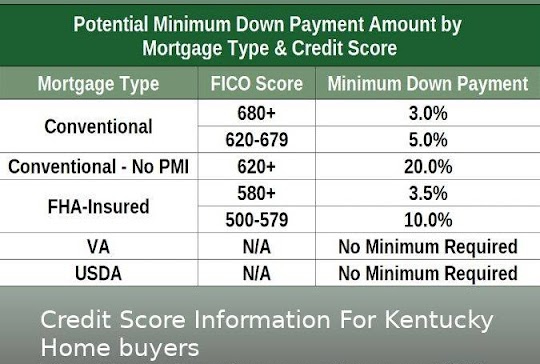
Kentucky VA Loans which are backed by the Department of Veteran Affairs, are specifically designed for active-duty military personnel, veterans, and their families. Here are a few benefits of Kentucky VA loans:
No down payment
One of the most significant advantages of a Kentucky VA loan is that it often allows for 100% financing. This means you may not have to make a down payment, making homeownership more accessible.
Lower interest rates
Kentucky VA loans typically offer competitive interest rates compared to conventional mortgages.
Kentucky VA loans tend to have more flexible credit requirements than conventional mortgages. While a good credit score is still important, the VA loan program may be more forgiving of past financial difficulties with no minimum credit score subject to approval
The view and opinions stated on this website belong solely to the authors, and are intended for informational purposes only. The posted information does not guarantee approval, nor does it comprise full underwriting guidelines. This does not represent being part of a government agency. The views expressed on this post are mine and do not necessarily reflect the view of my employer. Not all products or services mentioned on this site may fit all people. NMLS ID# 57916, (www.nmlsconsumeraccess.org).
Please see the no score requirements below Kentucky FHA, VA, USDA and Fannie Mae Mortgage Loan . Note: for government, at least one borrower must have a score.
Conventional:
A/E AUS required
No scores acceptable
12 months housing history required
FTHB education required
All borrowers must occupy
Priced off borrower w/ fico OR 580 if no scores
FHA:
A/E AUS required. These cannot be done as a manual. Non-occupant co-borrower income cannot be used to qualify and debt must be included in DTI unless approve eligible.
One borrower must have a score
12 months housing history required
Borrower with no fico must have 3 HUD acceptable alternative tradelines
FHA – IF 1 BORROWER HAS NO SCORE,
VA - IF 1 BORROWER HAS NO SCORE, THE BORROWER WITH THE SCORE NEEDS TO BE INPUT AS THE CREDIT SCORE FOR PRICING
USDA - IF 1 BORROWER HAS NO SCORE,
Joel Lobb Mortgage Loan Officer
American Mortgage Solutions, Inc. 10602 Timberwood Circle Louisville, KY 40223 Company NMLS ID #1364
The view and opinions stated on this website belong solely to the authors, and are intended for informational purposes only. The posted information does not guarantee approval, nor does it comprise full underwriting guidelines. This does not represent being part of a government agency. The views expressed on this post are mine and do not necessarily reflect the view of my employer. Not all products or services mentioned on this site may fit all people. NMLS ID# 57916, (www.nmlsconsumeraccess.org).
KHC's Mortgage Revenue Bond (MRB) program, receiving a below-market, 30-year fixed interest rate of 6% at a time when most mortgage interest rates are above 7%.
As a first-time homebuyer, Ashley was able to take advantage of KHC's Mortgage Revenue Bond (MRB) program, receiving a below-market, 30-year fixed interest rate of 6% at a time when most mortgage interest rates are above 7%.
Today we are going to talk about every student’s least favorite subject, their student loans. I also recognize that this issue has become quite a hot button topic so I will attempt to tap dance around both sides of the political aisle and stick to the facts. The fact is those can be difficult to find depending on where the loan holder is finding the information so today we are going to attempt to provide some clarity.
September 1, 2023 the COVID student loan forbearance is a thing of the past and despite new strains and new cases and new blah blah blah whether we agree or disagree, one thing is true, student loans are due. My team has spoken with dozens if not hundreds of clients in the past year that were 100% convinced that their student loans were going to be forgiven and for some that has actually happened, but others are in for a rude awakening if they aren’t properly armed with the right information.
We will link the full article for the SAVE Plan here but also wanted to give you a summary that you can pass along to your borrowers to ensure that you don’t have a random 90 day late popup on their report when you repull before closing. Short version the Saving on a Valuable Education (SAVE) Plan calculates a student loan payment based on income and family size. The SAVE plan will replace the REPAYE plan (Revised Pay As You Earn) and anyone who was enrolled in the prior plan will automatically be migrated over to the SAVE plan. The biggest difference is under the previous plan monthly payments were generally equal to 10% of the payee’s discretionary income divided by 12 months. Under the new plan that number is 5% of the discretionary income divided by 12 AND they have also increased the income exemption from 150% of the poverty line to 225%. If this doesn’t make some of you ask, “should someone living at 180% of the federal poverty line be buying a home right now?” then I will only assume that you stopped reading after the first paragraph but if you’re still with me, I will say that is a very fair question. It still doesn’t change the fact that anyone with looming student loan payments coming due can certainly benefit from this information.
There are currently half a dozen repayment options available to borrowers as of now; standard, graduated, extended, SAVE, pay as you earn, income based, income contingent and income sensitive. Who would have thought that a federal bureaucracy could have turned one option into 8 or more different flavors but with students graduating with a record number of scissors, thankfully they will still have plenty of red tape to keep them busy. All jokes aside, one thing that we hope everyone walks away with into their next client conversation with, STUDENT LOANS NEED TO START BEING PAID and if they don’t do it soon, their credit will start to be impacted regardless of income, desire or ability to repay.
SAVE Repayment Plan Offers Lower Monthly Loan Payments
The Saving on a Valuable Education (SAVE) Plan, like other income-driven repayment (IDR) plans, calculates your monthly payment amount based on your income and family size. The SAVE Plan provides the lowest monthly payments of any IDR plan available to nearly all student borrowers.
That means you will not owe loan payments if you are a single borrower earning $32,800 or less or a family of four earning $67,500 or less (amounts are higher in Alaska and Hawaii). Borrowers earning more than these amounts will save at least $1,000 per year compared to the current income-driven repayment plans.
The plan eliminates 100% of remaining interest for both subsidized and unsubsidized loans after a scheduled payment is made.
If you make your monthly payment, your loan balance won’t grow due to unpaid interest.
For example: If $50 in interest accumulates each month and you have a $30 payment, the remaining $20 would not be charged.
The SAVE Plan excludes spousal income for borrowers who are married and file separately.
This change removes the need for your spouse to cosign your IDR application.
When can I apply for the SAVE Plan?
The updated IDR application is now available and includes the option to enroll in the new SAVE Plan.
If you are enrolled in the REPAYE Plan or recently applied, you will be automatically enrolled in the SAVE Plan. There is no need to reapply or request to change your plan. Learn how to check which plan you’re on.
If you are already on an IDR plan, check to see if you are on the REPAYE Plan. Log in to StudentAid.gov, go to your My Aid page, scroll down, and view your loans. Each loan will list a repayment plan. If you see that you are enrolled in the REPAYE Plan, you’ll automatically be enrolled in the SAVE Plan later this summer. You can now enroll in the SAVE Plan if you’re on a different repayment plan. If you don’t have a StudentAid.gov account, create an account now.
Which loans are eligible for the SAVE Plan? Which loans are ineligible?
Eligible loans for the SAVE Plan include
Direct Subsidized Loans,
Direct Unsubsidized Loans,
Direct PLUS Loans made to graduate or professional students, and
Direct Consolidation Loans that did not repay any PLUS loans made to parents.
Loans that must first be consolidated into a Direct Consolidation Loan to be eligible for repayment under the SAVE Plan are
Subsidized Federal Stafford Loans (from the FFEL Program),
Unsubsidized Federal Stafford Loans (from the FFEL Program),
FFEL PLUS Loans made to graduate or professional students,
FFEL Consolidation Loans that did not repay any PLUS loans made to parents, and
Federal Perkins Loans.
Loans that are ineligible for repayment under the SAVE Plan are
Direct PLUS Loans made to parents,
Direct Consolidation Loans that repaid PLUS loans made to parents,
FFEL PLUS Loans made to parents,
FFEL Consolidation Loans that repaid PLUS loans made to parents, and
any loan that is currently in default.
If your loans are in default, you may qualify for the Fresh Start initiative to easily get your loans back in good standing. It’s free and takes 10 minutes or less to sign up and enroll in an affordable repayment plan, such as the SAVE Plan, with payments as low as $0 a month.
How much will I pay each month?
The SAVE Plan calculates your monthly payment based on your income and family size. Starting this summer, if you’re making $32,800 per year or less, roughly $15 dollars per hour, your monthly payment will be $0. If you make more than that, you could save at least $1,000 per year compared to other IDR plans.
Starting next summer, borrowers on the SAVE Plan will have their payments on undergraduate loans cut in half (reduced from 10% to 5% of income above 225% of the poverty line). Borrowers who have undergraduate and graduate loans will pay a weighted average of between 5% and 10% of their income based on the original principal balances of their loans.
What other changes to income-driven repayment are coming this summer?
We are launching the following changes to the income-driven repayment application and process this summer.
Update to IDR
What This Means
You can now grant us annual access to your latest IRS tax returns, safely and securely.
When you apply for or recertify your IDR plan, you can provide approval for the secure disclosure of tax information so that we can automatically access your latest IRS tax return.
You’ll save lots of time since you’ll no longer need to manually provide any income or family size information for your initial application or recertification.
You’ll save time and never miss your recertification date with first-ever automatic reenrollment in IDR plans.
If you agree to the secure disclosure of your tax information, we and your loan servicer will automatically recertify your enrollment in IDR and adjust your monthly payment amount once a year. You’ll be notified when your payment is changing and you’ll always be able to recertify your plan manually.
Note: Auto-recertification will be available in July 2024. If you apply for IDR electronically in August 2023 or later and you agree to securely share your tax information, then your plan will automatically be recertified the next time your recertification is due.
End of interest capitalization when a borrower leaves most IDR plans
As of July 1, 2023, unpaid interest on your loans won’t be added to your principal when you leave any IDR plan, except the Income-Based Repayment (IBR) Plan (where capitalization is required by statute).
User-friendly application
The redesigned application will allow you to enroll in IDR in 10 minutes or less, save your progress, and track your application via your StudentAid.gov account.
When do I need to apply for SAVE to see the change reflected in my first bill?
Borrowers currently enrolled in the REPAYE Plan will see their monthly payments automatically adjusted to the new SAVE Plan before payments restart. Most borrowers who apply for the SAVE Plan by mid-August will have their new monthly payment amount reflected in the billing statement sent to them in September for their first payment in October.
After you apply, check the status of your application by visiting your account dashboard on StudentAid.gov.
Some borrowers may receive disclosure from their servicer as early as August. For those borrowers, this is intended to inform you of your monthly payment. If you applied for the SAVE Plan close to your servicer’s bill issue date or before your required payment due date, your servicer will place you in a forbearance status for the upcoming billing cycle so that you do not pay more than you need to. Your servicer will also place you in forbearance if they cannot process your application before these dates.
Additionally, you can find the most up-to-date information on your monthly payment amount by logging onto your account with your student loan servicer.
What are the SAVE Plan benefits going into effect next year?
The SAVE Plan includes additional benefits that will go into effect in July 2024. These additional benefits will likely reduce payments further and make it easier to manage repayment. The benefits include the following:
Payments on undergraduate loans will be cut in half (reduced from 10% to 5% of income above 225% of the poverty line). Borrowers who have undergraduate and graduate loans will pay a weighted average of between 5% and 10% of their income based on the original principal balances of their loans.
Borrowers with original principal balances of $12,000 or less will receive forgiveness of any remaining balance after making ten years of payments, with the maximum repayment period before forgiveness rising by one year for every additional $1,000 borrowed. For example, if your original principal balance is $14,000, you will see forgiveness after 12 years. Payments made previously (before 2024) and those made from now on will count toward these maximum forgiveness timeframes.
Borrowers who consolidate will keep their progress toward forgiveness. They will receive credit for a weighted average of payments that count toward forgiveness based upon the principal balance of the loans being consolidated.
Borrowers will automatically receive credit toward forgiveness for specific periods of deferment and forbearance.
Borrowers can make additional “catch-up” payments to get credit for all other periods of deferment or forbearance.
Borrowers who are 75 days late will be automatically enrolled in IDR if they have agreed to allow the U.S. Department of Education to securely access their tax information.
How can my monthly payment amount be $0?
IDR plans protect a minimum amount of income to ensure you can cover basic necessities like food and housing costs. Since IDR plans are calculated based on income and family size, if your household income is below that level, you will have a $0 monthly payment. Each time you recertify your IDR plan with updated income and family size information, you may see your payment adjusted.
If you have a $0 payment due, you do not need to pay anything that month. Just make sure you know your recertification date. When applying for IDR, we recommend you consent to securely sharing your tax information so that we can automatically recertify your IDR enrollment for you. This way, you’ll never miss your recertification date and won’t have to fill out a recertification application.
Tip: If you have additional money in your budget to pay down your student loan balance, you can always set a custom payment amount each month, even if you have a $0 payment.
What happens if I apply for IDR after my servicer has already generated my first bill?
If you apply for the SAVE Plan close to your servicer’s bill issue date or before your required payment due date, your servicer will place you in a forbearance status for the upcoming billing cycle so that you do not pay more than you need to. Your servicer will also place you in forbearance if they cannot process your application before these dates.
You can check your application status by logging onto your account with your student loan servicer.
What happens if I submit multiple IDR applications?
Servicers process applications in the order they are received. Any applications you submit will be processed in the order you submit them.
How do I complete the application if I have limited internet access?
The IDR application is available online and in paper form (downloadable via PDF). The online applications is available in English, and the paper form is available in English and Spanish. The online applications is compliant with Section 508 of the Rehabilitation Act of 1973, as amended, to ensure access to individuals with disabilities.
If you do not have internet access or need a paper version of the application, you can download a PDF copy of the Income-Driven Repayment Plan Request form, print it, fill it out, and mail it to your loan holder as described on the application. You can also contact us to request a physical copy to be mailed to you.
How do I complete the application if I have a disability?
If you need help filling out any of the forms, you can reach our contact center. If you’re deaf or hard of hearing, you can get help from our contact center through chat or email. You can also contact us using a Video Relay Service.
How do I complete the application if I speak a language other than English?
If you speak a language other than English, our contact center provides support for over 100 common languages, including Spanish, Chinese, and French.
How do I complete the application if I live outside of the United States?
If you’re an American living outside the United States, you can access the IDR application without having to use a virtual private network (VPN). If you have any issues accessing the form while abroad, please reach out to our contact center.
Have Questions or Need Expert Advice? Text, email, or call me below:
Joel Lobb Mortgage Loan Officer Individual NMLS ID #57916
American Mortgage Solutions, Inc. 10602 Timberwood Circle Louisville, KY 40223 Company NMLS ID #1364
The view and opinions stated on this website belong solely to the authors, and are intended for informational purposes only. The posted information does not guarantee approval, nor does it comprise full underwriting guidelines. This does not represent being part of a government agency. The views expressed on this post are mine and do not necessarily reflect the view of my employer. Not all products or services mentioned on this site may fit all people. NMLS ID# 57916, (www.nmlsconsumeraccess.org).