Whether you’re buying your first home, using down payment assistance, or rebuilding credit — there’s a program that fits. Compare them side by side before you commit.
🏠 FHA Loan
The go-to for first-time buyers and 580+ credit. Low down payment and flexible guidelines.
The White House is reportedly considering a draft executive order titled "Decreasing Housing Costs for the American People," first obtained by Scotsman Guide and also reported by HousingWire . As of this writing it has not been signed , and the final details could change. Here is what the current draft includes and why Kentucky borrowers should keep an eye on it. What the Draft Proposes Reducing or eliminating certain loan-level pricing fees on eligible refinances Waiving appraisals and some documentation on qualifying refinances that lower your payment Expanding title insurance waivers to reduce closing costs Directing the VA and USDA to pursue lower rates for eligible borrowers Requiring servicers to notify you when you may qualify to remove mortgage insurance Who in Kentucky Could Benefit Homeowners who bought or refinanced at higher rates over the past few years Veterans and military families, including those near Fort Knox and Fort Campbell Rural home...
Get link
Facebook
X
Pinterest
Email
Other Apps
Getting a Kentucky Mortgage in 3 Simple Steps
No confusing paperwork trails. No surprise fees. A clear path from first call to keys in hand.
01
💬 Get Pre-Qualified
Free application review with same-day answers. We look at your credit, income, and goals — no cost, no obligation, no pressure.
02
📋 Compare Your Options
FHA vs. Conventional vs. USDA vs. KHC — run side by side with your actual numbers so you see the real payment before you commit.
03
🏠 Close & Get Your Keys
Guided from contract to closing — appraisal, title, and underwriting coordinated so you always know what happens next.
Watch: Kentucky Mortgage Guides
Straight answers from my YouTube channel — no jargon, no sales pitch.
Hi, I’m Joel Lobb — a Kentucky dad who’s spent 20+ years helping families across all 120 counties buy their first home. When you call, you get me — not a phone tree. Questions on a Saturday morning? I answer.
1,300+ Kentucky families have trusted me with their mortgage — from Louisville to Lexington to the smallest towns in the state. Free application reviews, same-day pre-approvals, and honest answers about what you actually qualify for.
Kentucky VA Manual Underwriting: How to Get a VA Loan With Bad Credit (2026)
Get link
Facebook
X
Pinterest
Email
Other Apps
-
Updated November 14, 2026 · By Joel Lobb, Kentucky Mortgage Loan Officer, NMLS #57916 · Sources: VA Lender's Handbook M26-7, Chapter 4 (Credit Underwriting) and 38 CFR 36.4340
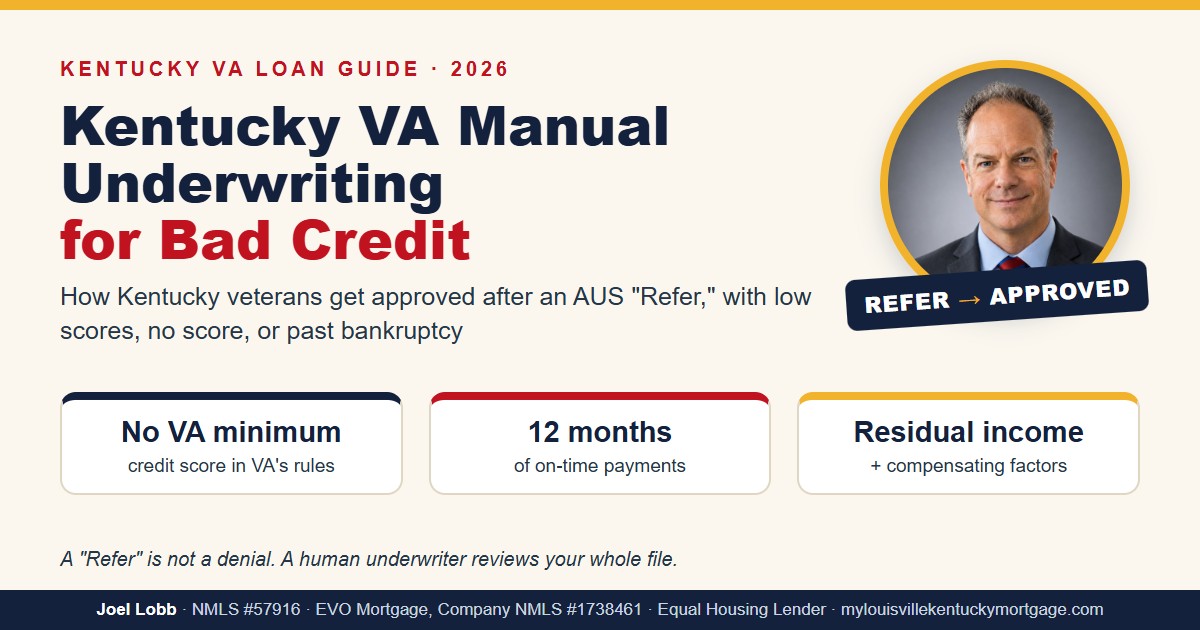
Quick answer: If the automated system gives your Kentucky VA loan a Refer, that is not a denial. It means a VA-approved underwriter has to review your file by hand. That's VA manual underwriting. Here's what that underwriter looks for:
Credit score: the VA itself has no minimum credit score. Lenders set their own floor, often 580 to 620. I can go as low as a 550 score on a manually underwritten VA loan. Kentucky Housing (KHC) requires 620.
Payment history:12 months of on-time payments since your last late payment, collection or other credit problem.
Bankruptcy and foreclosure: Chapter 7 discharged at least 2 years, Chapter 13 with 12 on-time plan payments and trustee approval, or a foreclosure at least 2 years old.
Money left over: enough residual income each month. For a Kentucky family of four that's at least $1,003, or about $1,204 if your debt-to-income ratio is over 41%. I don't put a set DTI cap on manual VA files. Residual income and compensating factors decide.
Rent history: on a Refer, up to 24 months of rent verified, with the most recent 12 months paid on time.
Job history:2 years of work verified. Explain any gap longer than 30 days. If you're leaving the military within 12 months of closing, you'll need a re-enlistment, a civilian job offer or retirement income.
Collections and disputes: medical collections can be ignored. Other collections count as 5% of the balance ÷ 12. A disputed account can be set aside only for a real dispute, and never on a judgment.
Strengths: real compensating factors, such as savings, steady work, or a new house payment close to your current rent.
Watch: VA Manual Underwriting in 2 Minutes
What Is VA Manual Underwriting?
Most VA loans start in an automated underwriting system (AUS), usually Fannie Mae's Desktop Underwriter (DU). Freddie Mac's Loan Product Advisor and some lenders' own VA-approved systems are also allowed. The AUS reads your credit report, income, assets and debts and returns a finding:
AUS findings on a VA loan and what each one means
AUS finding
What it means
What happens next
Approve/Eligible
The risk looks acceptable and the loan fits VA rules.
Standard documentation. A human underwriter still reviews and signs off.
Approve/Ineligible
The risk is fine, but something doesn't fit the program, such as the loan amount or property type.
Fix the eligibility issue, or the lender decides whether it can still be a VA loan.
Refer/Eligible
The computer can't approve it. Under Fannie Mae's rules the loan "must be manually underwritten" by a VA-approved underwriter.
VA manual underwriting. More documents, a full credit review, and residual income and DTI checked by hand.
Refer/Ineligible
Manual review needed, plus an eligibility issue.
Fix the eligibility issue, then manual underwriting.
What a VA manual underwriter actually does
On a Refer, a VA-approved underwriter at the lender works through your file line by line and records the decision on VA Form 26-6393, Loan Analysis. That includes:
Reading your full credit report and rating your rent and mortgage history
Reading your letters of explanation and the proof behind them
Calling your employer to verify the job and checking at least a month of pay stubs
Working out residual income and DTI by hand
Writing down which compensating factors justify the approval, especially if DTI is over 41%
The AUS can't do two things a person can: weigh why something happened, and give credit for strengths a computer doesn't score. That's where a well-prepared file wins.
The VA's own handbook is clear that the computer isn't the final word. Automated systems "do not approve or disapprove loans. They merely determine a risk classification." The approval decision belongs to a person. VA even tells underwriters it "encourages underwriters to find ways to approve loan applications which ought to be approved but may not appear approvable upon direct application of the credit standards."
That's why manual underwriting is often the path for Kentucky veterans who were told "no" somewhere else. A human looks at the reasons behind the credit report, not just the score.
Wording tip: You'll see many websites (and AI chatbots) say VA loans get "Refer with Caution." Fannie Mae issues that finding only on conventional loans. A VA file gets Refer/Eligible or Refer/Ineligible. If your loan officer says "Refer," that's the manual underwriting path.
Why a Kentucky VA Loan Gets a Refer
A file can land in manual underwriting two ways. The AUS can return a Refer, or the lender can be required to downgrade an Approve to a Refer. VA's handbook (Chapter 4, Topic 8) requires the downgrade when:
Any mortgage shows more than one 30-day late payment in the past 12 months.
A significant debt that isn't on your credit report (one with a payment over 2% of your income) shows more than one 30-day late in the past 12 months.
Any account is currently 90 or more days past due.
Other common reasons Kentucky borrowers end up manually underwritten:
A low credit score, or no credit score at all
A thin credit file, such as only one or two accounts
A Chapter 7 or Chapter 13 bankruptcy in the last few years
A foreclosure, short sale or deed-in-lieu
Collections, charge-offs or recent late payments
A high debt-to-income ratio
Income that's new, irregular or hard for the AUS to read
What a VA Manual Underwriter Checks
Kentucky VA loans after an AUS Refer
Your last 12 months. On-time payments since your last problem. This matters more than the score.
The reason. Job loss, medical bills or a layoff, explained in writing and documented.
Bankruptcy and foreclosure timing. Usually 2 years for Chapter 7 or foreclosure, 12 plan payments for Chapter 13.
Federal debt. No delinquent federal debt, such as taxes, student loans or a VA overpayment, unless it's current or on an approved plan.
Residual income and DTI. Kentucky family of 4: $1,003 or more left each month. Over 41% DTI, aim for about $1,204.
Real strengths. Savings, long time on the job, low payment shock and little consumer debt.
Source: VA Lender's Handbook M26-7, Chapter 4 · Joel Lobb, NMLS #57916
Is There a Minimum Credit Score for a VA Loan in Kentucky?
Not from the VA. Chapter 4 of the VA Lender's Handbook says it in one line: "VA does not have a minimum credit score requirement." The VA tells underwriters to focus on "overall payment patterns rather than isolated occurrences."
The score floors you hear about come from lenders and investors, and they're called overlays:
Who sets the credit score minimum on a Kentucky VA loan
Who
Typical minimum
What it means for you
The VA (Lender's Handbook)
None
Payment pattern, residual income and the reasons behind problems decide the file.
Many national lenders
620
Below 620, many lenders stop. Others will manually underwrite.
Some lenders and brokers
580, case by case
Often limited to manual underwriting with tighter DTI and documentation.
Joel Lobb, EVO Mortgage
550
Manual VA underwriting down to a 550 score, with no set DTI cap. Residual income, your last 12 months and compensating factors decide the file.
If you don't have a credit score at all, that's not automatically a problem. The VA says "absence of a credit history is not generally considered an adverse factor." The underwriter can use nontraditional credit instead, such as rent, utilities, phone, insurance or other bills you can prove you paid on time. See how rent and utility payments count toward approval.
Want to see how paying down a card or removing a late payment could move your score? Try my free Kentucky credit score simulator.
VA Credit History Rules for Manual Underwriting
The VA cares most about your pattern. Its rule of thumb is that satisfactory credit is "re-established after the borrower(s) have made satisfactory payments for 12 months after the date the last derogatory credit item was satisfied." Here's how the main problems are treated:
Discharged 2+ years: may be disregarded. 1 to 2 years: possible only with new good credit and a documented cause beyond your control (job loss, uninsured medical bills). VA says divorce generally doesn't count as beyond your control. Under 12 months: generally not possible.
Chapter 13 bankruptcy
Still in the plan: 12 months of on-time plan payments plus the trustee's or judge's approval of the new mortgage. Plan completed: credit may be considered re-established.
Foreclosure / deed-in-lieu
Finalized 2+ years ago: may be disregarded. If it was a VA loan, check your Certificate of Eligibility; some entitlement may still be tied up.
Short sale
If payments were current before the sale and you worked with the servicer, a waiting period "may not be necessary."
Medical collections
May be ignored completely. No payoff or explanation needed, unless they've become a judgment or lien.
Non-medical collections (updated Aug. 2026)
Don't have to be paid off, but without a payment plan the underwriter counts 5% of the balance ÷ 12 as a monthly debt. Example: a $2,400 collection adds $10 a month. More on collections and charge-offs on VA loans.
Judgments
Paid in full, or on a repayment plan with a history of on-time payments (usually 12). Many lenders require a payoff.
Delinquent federal debt
Past-due federal debt (taxes, federal student loans, a VA overpayment) blocks approval until it's current or on an approved plan. Lenders check the CAIVRS database on every borrower.
Consumer credit counseling
Acceptable after 12 months of on-time plan payments, with the counseling agency's OK on the new mortgage.
Disputed accounts
The underwriter may consider a legitimate dispute, except on a debt that's become a judgment.
Rental history
On a Refer, expect to verify your last 24 months of rent through the landlord, the credit report or canceled checks.
One trap to avoid: paying off old collections after you apply doesn't erase them. VA says paying off debts after your credit is questioned "does not alter the unsatisfactory record of payment." What helps is 12 clean months from here on out.
Payment History: Why Your Last 12 Months Matter Most
A manual underwriter reads your credit report like a timeline. Older problems count for less if the most recent year is clean. VA tells underwriters to focus on "overall payment patterns rather than isolated occurrences of unsatisfactory repayment."
Mortgage lates are the strictest. More than one 30-day late on a mortgage in the past 12 months forces a Refer, even if DU said Approve. Expect a written explanation.
Anything 90+ days late right now also forces a Refer. Bring every account current before you apply.
Car loans, cards and student loans: a single late more than a year ago, with on-time payments since, is usually explainable. Several lates in the last few months are not.
New debt counts too. Opening new cards or a car loan right before a manual file makes it harder. VA asks whether debts piled up while you were paying less for housing.
Letters of explanation: keep them short, factual and backed by proof. Say what happened, when, why it's over, and what's different now. For example: "I was laid off from March to June 2025. I started at my current employer in July 2025 and every account has been paid on time since." Attach the layoff notice or the new offer letter.
Rent History on a VA Manual Underwrite
On an automated Approve, VA doesn't require rent verification at all. On a Refer it does. The handbook calls for a "24 month rental history directly from the landlord, through information shown on credit report or by cancelled checks." Your rent is the closest thing to a house payment the underwriter can see, so it carries real weight:
The most recent 12 months need to be on time. Many lenders treat a late rent payment in the last year like a late mortgage payment.
Professional landlord or apartment complex: a verification of rent (VOR) form filled out by the management office is usually enough.
Private landlord or a family member: expect to show canceled checks or bank statements with the rent leaving your account each month, plus the lease. Cash rent is very hard to prove, so start paying by check or transfer now.
Living rent-free with family? That isn't a negative, but you lose the rent-history strength. A letter from the homeowner explains it, and other compensating factors have to carry more of the file.
Rent close to the new payment is a VA compensating factor ("little or no increase in shelter expense").
Collections are where VA is more forgiving than most borrowers expect, and where the August 2026 handbook update matters most:
Medical collections: "Lenders may disregard all identifiable medical collections, including charge-off accounts, that have not been reduced to a judgment or lien." No payoff and no letter needed.
Non-medical collections: you don't have to pay them off. Without a payment plan, the underwriter adds a payment of 5% of the balance ÷ 12 to your DTI and residual income. A $1,200 collection adds $5 a month, and a $6,000 one adds $25.
On a payment plan: the underwriter uses the actual plan payment instead, so get the agreement in writing.
Charge-offs: don't have to be paid, but the underwriter has to address what caused them, so write a letter of explanation.
Recent collections hurt more than old ones. A collection from last month resets the 12-month clock. One from four years ago, with clean credit since, is usually explained in a sentence.
Judgments and federal debts are different. A judgment must be paid or on a plan with a history of on-time payments. Past-due federal debt must be brought current. These are the two items that stop a VA file cold.
The VA rule is short: lenders "may consider a Veteran's claim of bona fide or legal defenses regarding unpaid debts except when the debt has been reduced to judgment," and the underwriter has to document why an account was left out.
In practice, here's how disputes play out on a Kentucky VA file:
A real dispute can be set aside. Examples are identity theft, an account that isn't yours, or a bill you already paid. Bring the proof, such as a police or FTC identity theft report, the creditor's letter, or a paid receipt.
A dispute on a judgment doesn't count. Once a court has ruled, the debt has to be paid or on a plan.
Disputes can make your score unreliable. While an account is marked "in dispute," the credit score may leave it out. Many lenders ask you to resolve open disputes, or remove the dispute remark and re-pull credit, before they run DU. When the remark comes off, your score can drop.
Don't dispute accurate accounts to try to raise your score. It usually delays the loan and can backfire.
Medical collections don't need to be disputed for VA. They can be ignored anyway.
Bankruptcy, Foreclosure and the Manual Underwriter
A bankruptcy or foreclosure doesn't end your VA eligibility. The underwriter looks at the date, the cause, and how you've handled credit since:
Chapter 7: more than 2 years since discharge, and it can be disregarded. Between 1 and 2 years, you need re-established credit and a documented cause beyond your control, such as a layoff or uninsured medical bills. VA says divorce generally doesn't qualify. Under 12 months is generally not possible.
Chapter 13: you can buy while you're still in the plan after 12 months of on-time payments, with written approval from the trustee or judge. If the plan is finished, credit may be considered re-established.
Bankruptcy from a failed business: it can be looked at more favorably if all four of these are true:
You've had a steady job since the business failed.
You had no credit problems before the business.
You've had none since the bankruptcy.
The failure wasn't caused by misconduct.
Bankruptcy and foreclosure: the clock runs from the later date, either the discharge or the date the house changed hands.
Bring the paperwork: the petition, all schedules and the discharge. For Chapter 13, add the trustee's payment history and approval letter.
The underwriter has to believe your income will continue. VA's rule is to "verify a minimum of 2 years of employment," and it calls 2 years in your current job "a positive indicator of continued employment." It doesn't have to be the same employer:
Under 2 years at your current job: the lender verifies your previous jobs to cover the full 2 years, or documents why it can't.
Gaps in work: on a Refer, any gap longer than 30 days needs a written explanation. On an Approve, the cutoff is 60 days.
Verification: expect a phone call to your employer and pay stubs covering at least one full month, showing year-to-date pay, overtime and bonus.
Commission, overtime and bonus: usually need a 2-year history to count. Commission income under a year "can rarely qualify."
Same line of work, new employer: moving to a better job in the same field is a positive, not a red flag.
Long time on the job is a VA compensating factor, but VA says it can't make up for low residual income. Savings can.
Leaving the Military for a Civilian Job
This is the situation I see most around Fort Knox and Fort Campbell. Active-duty base pay is considered stable, unless you're within 12 months of leaving. If your ETS date on your Leave and Earnings Statement (LES) falls within 12 months of the closing date, VA requires one of these:
Proof you've already re-enlisted or extended past that 12-month window
A verified offer of local civilian employment, and/or verified military retirement income
Your statement that you intend to re-enlist, plus your commanding officer's statement that you're eligible and nothing suggests it will be denied
Unusually strong factors, such as 10% down from your own funds, 6 months of payments in savings after closing, or strong local ties plus a spouse's income high enough to carry the loan
A few more things to know:
Recently discharged veterans often have little work history outside the military. VA tells underwriters to "exercise a great deal of judgment and flexibility." A civilian job that uses the same skills you used in the service is a strong sign the income will continue.
Active duty files use your LES, not W-2s or an employer verification form.
Guard and Reserve members on activation orders are usually qualified on civilian income if it's lower than the activation pay.
Officers whose LES shows an ETS of 888888 or 000000 don't need the extra documents.
Disability claim in progress at separation? If you get a proposed or memorandum disability rating before closing, you're exempt from the funding fee. Tell your loan officer early so they can ask VA to check.
Residual Income and DTI: The Numbers That Decide Most Manual Files
For VA loans, the debt-to-income ratio (DTI) is secondary. The handbook calls it "a guide" that is "secondary to the residual income." Residual income is the money your household has left each month after taxes, the new house payment, utilities and maintenance, and your debts.
VA residual income for Kentucky (South region)
Minimum monthly residual income, South region (includes Kentucky)
Family size
Loan $79,999 or less
Loan $80,000 or more
Over 41% DTI (×1.2, loans $80K+)
1
$382
$441
$530
2
$641
$738
$886
3
$772
$889
$1,067
4
$868
$1,003
$1,204
5
$902
$1,039
$1,247
6–7
+$75 each
+$80 each
+$96 each
These figures come from VA Lender's Handbook Chapter 4 and 38 CFR 36.4340. They have not changed for 2026, even though some sites label them "new 2026 tables." The right-hand column is rounded up from 120% of the guideline. Full chart and calculator: VA residual income chart for Kentucky.
The 41% rule
VA's benchmark DTI is 41%. It's a guideline, not a hard cap. Above 41%, the loan needs a written justification signed by the underwriter's supervisor listing your compensating factors, unless your residual income beats the chart by at least 20%. Many lenders still cap manually underwritten VA loans somewhere around 45% to 50%. I don't set a DTI cap on manual VA files. If your residual income is strong and the compensating factors are real, a higher ratio can still be approved. Check your numbers with my Kentucky DTI calculator.
Military households near Fort Knox and Fort Campbell
If you're active duty or retired and will keep using base services, the lender can lower the residual income requirement by 5%. A family of four's $1,003 becomes about $953. That's a real advantage for buyers around Fort Knox (Hardin, Meade and Bullitt counties) and Fort Campbell (Christian and Trigg counties).
Worked example: Louisville family of four
Example only. Your figures will differ.
Gross monthly income
$5,600
Taxes (federal, state, Social Security, Medicare)
− $950
New house payment (P&I on $255,375 at 7.0%, plus taxes and insurance)
− $2,016
Maintenance and utilities (1,500 sq ft × $0.14)
− $210
Car, credit cards and a $2,400 collection counted at $10
− $530
Residual income
$1,894
DTI ($2,016 + $530) ÷ $5,600
45.5%
The DTI is above 41%, but residual income of $1,894 is well over the $1,204 needed for the 20% cushion. A file like this has a real shot at a manual approval if the last 12 months of credit are clean. (Some lenders would stop at 45%. I don't set a DTI cap on manual VA files.)
Compensating Factors That Actually Help
The VA lists the compensating factors an underwriter can lean on:
Counts as a strength
Excellent long-term credit
Conservative use of consumer credit
Minimal consumer debt
Long-term employment
Significant liquid assets (savings after closing)
Sizable down payment
Little or no increase in housing payment
Military benefits
Satisfactory homeownership experience
High residual income and low DTI
Continuing tax credits, such as child care
Doesn't count
Just meeting the minimums. VA says factors must be "strengths rather than mere satisfaction of basic program requirements."
Having enough cash to close
A strength that doesn't fit the weakness. VA's example: savings can offset low residual income, but long-term employment can't.
Using any factor to excuse current bad credit. VA says compensating factors "cannot be used to compensate for unsatisfactory credit."
Match the strength to the weakness
VA says a compensating factor has to logically offset the specific problem. Here's how that typically lines up:
Which compensating factors offset which weaknesses
Weak spot in the file
Strengths that can offset it
DTI over 41%
Residual income 20%+ over the chart, savings after closing, little or no payment increase, long job history
Residual income just under the chart
Significant liquid savings, a down payment, a payment close to current rent
Big jump from rent to house payment
A record of saving the difference, low consumer debt, reserves
Old credit problems
12+ clean months, conservative use of credit, a documented one-time cause
Short time on the job or leaving the military
Same line of work, military retirement income, a verified job offer, savings
One more thing that matters on manual files is payment shock. If your new payment is far above your current rent, the underwriter will want to see that you've been saving the difference. Keeping your new payment close to your rent is itself a compensating factor.
Documents for a Kentucky VA Manual Underwrite
Manual files need more paper than automated ones. Have these ready:
30 days of pay stubs and 2 years of W-2s (tax returns if self-employed or paid commission)
24 months of rent history: a landlord verification, canceled checks or bank statements
2 months of bank statements, all pages
A signed letter of explanation for each late payment, collection or derogatory account
Bankruptcy petition, schedules and discharge, or for Chapter 13 the payment history and trustee approval letter
Proof of any payment plans (judgments, IRS or other federal debt)
For no-score files: 12 months of proof for rent, utilities, phone or insurance
Award letters for VA disability or other benefits
Active duty: your most recent LES. If your ETS is within 12 months of closing, add re-enlistment or extension papers, a civilian job offer, or retirement income proof
A letter explaining any job gap longer than 30 days
For a disputed account: proof of the dispute, such as an identity theft report, the creditor's letter or a paid receipt
Written payment agreements for any collections or judgments on a plan
What Kentucky VA Buyers Should Know Right Now (November 2026)
Rates: Mortgage News Daily's 30-year VA index was 7.01% on November 12, 2026. Freddie Mac's weekly survey (conventional loans) was 7.11%. Each borrower's rate depends on credit, the lender's pricing and how many points are paid.
What that means for the payment: on a $250,000 home with $0 down and the 2.15% funding fee financed, principal and interest is about $1,701 a month at 7.01%, versus about $1,533 at 6.01%. That difference also lowers your residual income, so the rate really matters on a manual file.
Funding fee: 2.15% for first use with less than 5% down, 3.3% for later use, 1.5% with 5% down, and 1.25% with 10% down. Veterans receiving VA disability compensation are exempt. See VA funding fee and closing costs.
Loan limits: with full entitlement there's no VA loan limit. With partial entitlement, the 2026 baseline conforming limit of $832,750 is used in the calculation.
New in August 2026: VA updated its credit chapter to spell out how non-medical collections are counted (5% of the balance ÷ 12).
Days 1–7: Get the facts. Pull all three reports free at AnnualCreditReport.com. List every late payment, collection and judgment with its date. Check for federal debt at VA's debt management page.
Days 1–30: Stop new damage. Every account paid on time, starting now. The 12-month clock starts after your last problem.
Days 1–30: Deal with blockers. Get delinquent federal debt current or onto an approved plan. Set up payment plans on judgments.
Days 15–60: Build the paper trail. Collect 24 months of rent proof, write your letters of explanation, and document the cause of any hardship.
Days 30–90: Strengthen the file. Pay revolving balances below 30%. Save two to three months of payments. Shop for a payment close to your current rent.
Anytime: Talk to a lender who does manual VA files. A free HUD-approved counselor can also help. Find one through the CFPB counselor finder.
VA Bad-Credit Myths You'll See Online (Including on AI Chatbots)
"The VA requires a 620 score." False. That's a lender overlay. The VA has no minimum score.
"A Refer means you're denied." False. It means a human underwriter reviews the file.
"VA loans get Refer with Caution." That's a conventional-loan finding. VA files get Refer/Eligible.
"There are new 2026 residual income tables." The VA's figures haven't changed. Kentucky uses the South region.
"Pay off every collection before you apply." Not required by the VA, and it doesn't erase the history. Medical collections can be ignored.
"You can't have a VA loan after a VA foreclosure." Often you can after 2 years. Remaining entitlement and any VA debt decide it.
Got a Refer? Let's See If Your File Can Be Approved.
I've helped Kentucky veterans buy homes with VA loans for more than 20 years, including files other lenders turned down. I manually underwrite VA loans down to a 550 credit score with no set DTI cap. Send me your situation and I'll tell you honestly whether you're ready now or what to fix first. It's free, and the review won't affect your credit score.
Serving Louisville, Lexington, Elizabethtown, Radcliff, Hopkinsville, Bowling Green and all 120 Kentucky counties. Read what my clients say.
Kentucky VA Manual Underwriting FAQ
What credit score do I need for a VA loan in Kentucky?
The VA has no minimum. Most lenders want 580 to 620. I can go down to 550 on a manual underwrite. KHC requires 620 for its VA loans and down payment assistance. With a lower score or no score, a manual underwrite may still be possible if your last 12 months of payments are clean and your residual income is strong.
Can I get a VA loan 1 year after Chapter 7 bankruptcy?
It's difficult. The VA says a discharge 1 to 2 years ago is "probably not possible" unless you've rebuilt good credit and the bankruptcy was caused by something beyond your control, such as job loss or uninsured medical bills, and that's documented. After 2 years, the bankruptcy can be disregarded.
Can I get a VA loan while in Chapter 13?
Yes. You'll need at least 12 months of on-time plan payments and written approval from your trustee or bankruptcy judge for the new mortgage.
What is the maximum DTI for a VA manual underwrite?
The VA has no hard cap. 41% is the benchmark. Above it, you need residual income at least 20% over the guideline, or a supervisor-signed justification with compensating factors. Many lenders cap manual VA files around 45% to 50%. I don't set a DTI cap: residual income and compensating factors decide.
How much residual income do I need in Kentucky?
Kentucky is in VA's South region. On a loan of $80,000 or more, it's $441 for one person, $738 for two, $889 for three, $1,003 for four and $1,039 for five, plus $80 for each extra household member up to seven.
Do I have to pay off collections for a VA loan?
No. Medical collections can be ignored. Non-medical collections don't have to be paid, but without a payment plan the underwriter adds 5% of the balance divided by 12 as a monthly payment. Judgments and delinquent federal debts are different: they need to be paid or on an approved plan.
Can I get a VA loan with no credit score?
Yes. The VA says having no credit history isn't an adverse factor. The underwriter can use rent, utilities, phone and insurance payments you can document, usually for at least 12 months.
How much rent history do I need for a VA manual underwrite?
On a Refer, VA calls for 24 months of rental history, verified by the landlord, the credit report or canceled checks. The most recent 12 months should be paid on time. With a private landlord, bank statements or canceled checks are the best proof.
Can I get a VA loan if I'm getting out of the military soon?
Yes. If your ETS date is within 12 months of closing, you'll need one of these: proof you've re-enlisted or extended, a verified civilian job offer or retirement income, a commanding officer's statement backing your intent to re-enlist, or strong factors such as 10% down or 6 months of payments in savings.
How long do I need to be on my job for a VA loan?
VA wants 2 years of employment verified, not necessarily with the same employer. If you've been at your current job less than 2 years, your prior jobs fill in the rest. On a manual underwrite, any gap over 30 days needs a written explanation.
Can I get a VA loan with disputed accounts on my credit?
The underwriter may consider a legitimate dispute, except on a debt that's become a judgment, and must document why the account was left out. Many lenders ask you to resolve open disputes or remove the dispute remark and re-pull credit before running the automated system.
How long does a VA manual underwrite take?
Usually a few days to a week or two longer than an automated approval, because of the extra verification. Having your documents ready up front is the biggest time saver.
How to Get Approved for a Mortgage Loan in Kentucky Thank you for visiting. I hope you find this website both informative and empowering as you explore your Kentucky mortgage options. My goal is simple: help you understand what mortgage underwriters actually review, help you avoid preventable approval issues, and help you choose the right loan program for your situation. I specialize in assisting Kentucky first-time homebuyers with FHA, VA, USDA Rural Housing, KHC down payment assistance , and Fannie Mae conventional mortgage loans . I proudly serve all 120 counties in Kentucky. FHA Loans in Kentucky VA Loans in Kentucky USDA Rural Housing Loans in Kentucky Fannie Mae Conventional Loans KHC Down Payment Assistance Programs With over 20 years of lending experience, I've had the privilege of helping more than 1,300 Kentucky families buy a home or refinance their current mortgage. Whether you are a first-time buyer, a veteran, a USDA buyer, a credit-challenged ...
Kentucky Welcome Home Grant 2026 Update: Program Closed and Out of Funds May 2026 update for Kentucky homebuyers: the 2026 Welcome Home Grant is now closed for new reservations. This does not mean you cannot buy a home. It means you need to pivot quickly to other Kentucky mortgage and down payment assistance options. May 2026 Update Welcome Home Grant Closed KHC DAP Still Available USDA, VA, FHA Options Important Update: The 2026 Welcome Home Grant Is Closed The 2026 Welcome Home Grant through FHLB Cincinnati is now closed and out of funds for new reservations . If your lender did not reserve the money before the program closed, you should not build your home purchase plan around receiving this grant for 2026. The hard truth: this grant was popular, limited, and first-come, first-served. Once the available funds were reserved, the program closed. Good News: Kentucky Buyers Still Have Options ...
If you are trying to figure out whether you earn too much to use a Kentucky Housing Corporation (KHC) loan, this page has the current numbers. Below are KHC's income limits by county, the maximum purchase price, the down payment assistance amounts, and the credit and debt-to-income rules that go with them — updated for 2026. The short answer KHC uses two different income-limit charts . Under the Secondary Market programs, most Kentucky counties allow up to $147,350 in qualifying income, rising to $195,650 in the Northern Kentucky counties. Under the lower Mortgage Revenue Bond (MRB) programs, most counties cap household income near $101,040 for a 1–2 person household and $117,880 for 3 or more. The maximum purchase price for either is $566,354 . $566,354 Max purchase price $12,500 Max down payment help 620 Min score (FHA/VA/RHS) 660 Min score (conventional) What Kentucky Housing Corporation Is — and Why the Income Limit Matters ...